Compliance Management
 Risk Management
 Third Party Risk Management
 Data Privacy Management
 Internal Auditing
 Business Continuity Management
 Continuous Control Monitoring (CCM)
 Trust Center
 AI Governance
- Data Privacy
- 2nd Sep 2026
- 1 min read
Vendor Risk Tiering: Why It Predicts Breach Cost

- Written by
In Short..
- Third-party risk is growing fast: Verizon's 2025 research found third-party involvement in breaches doubled year on year to 30%; SecurityScorecard's own analysis puts the figure at 35.5% of all breaches.
- Vendor type shapes both the odds of a breach and its cost: IBM's 2026 data shows AI models delivered by a third-party vendor cost more to breach ($5.35 million as SaaS, $5.26 million on-premise) than models an organisation trains and hosts itself ($4.98 million).
- Breaches identified by a third party take the longest to close: IBM found third-party-identified breaches averaged 281 days to identify and contain, the slowest of any detection route, and cost $4.98 million on average.
- A tier is a resourcing decision: It determines how deep an assessment goes, how often it repeats and what evidence gets collected, so the vendors that actually carry risk get real scrutiny instead of a shared questionnaire.
Third-party involvement in data breaches doubled to 30% in 2025, according to the Verizon Data Breach Investigations Report. SecurityScorecard puts the true share even higher, at 35.5%. Not every vendor carries the same risk, though, and treating them as if they do is what leaves organisations blindsided by a breach that started three steps removed from their own network.
Vendor tiering classifies suppliers by the risk they actually carry, instead of the order they signed a contract. It's how governance, risk, and compliance (GRC) teams turn that blind spot into something they can act on before it becomes an incident.
Expert View

Matt Davies Chief Product Officer, SureCloud |
What our experts say about vendor risk tiering
"Most third-party risk programmes fail for a boring reason: every vendor gets the same seventeen-question form, whether they process payment data or supply the office coffee machine. Tiering redirects that same effort. It's how you spend your assessment budget where the exposure actually is."
|
Third-party risk is growing faster than most GRC programmes are tracking it
The Verizon 2025 Data Breach Investigations Report found that third-party involvement in breaches doubled to 30% this year. SecurityScorecard's 2025 Global Third-Party Breach Report, based on its STRIKE Threat Intelligence Unit's analysis of 1,000 breaches, puts the figure at 35.5% of all breaches recorded. The two studies use different methodologies, so the exact percentages differ, but both point in the same direction. A growing share of breaches now start outside the organisation's own perimeter.
IBM's Cost of a Data Breach Report 2026, produced with the Ponemon Institute, adds a cost dimension to that trend. Third-party detection is the slowest route by far: breaches identified this way took 281 days on average to identify and contain, and cost $4.98 million.
Not every vendor carries the same risk
The instinct to treat third-party risk as one undifferentiated category is understandable. It's also where most vendor risk programmes lose their value. A single questionnaire, sent to every supplier regardless of what they actually touch, produces a stack of paperwork instead of a picture of where the real exposure sits.
What the numbers actually show
IBM's 2026 data offers a concrete illustration. Among AI-related breaches, models delivered by a third-party vendor as SaaS averaged $5.35 million to remediate, and vendor-deployed on-premise models averaged $5.26 million. Models an organisation trained and hosted in-house averaged $4.98 million, lower on both counts. The deployment source shows up as a concrete difference in cost.
IBM's data shows a correlation. Third-party AI deployments cost more to breach than in-house ones on average, and vendor type is one of the variables behind that gap. IBM stops short of calling it causal. A tiering model is built to capture exactly this kind of signal.
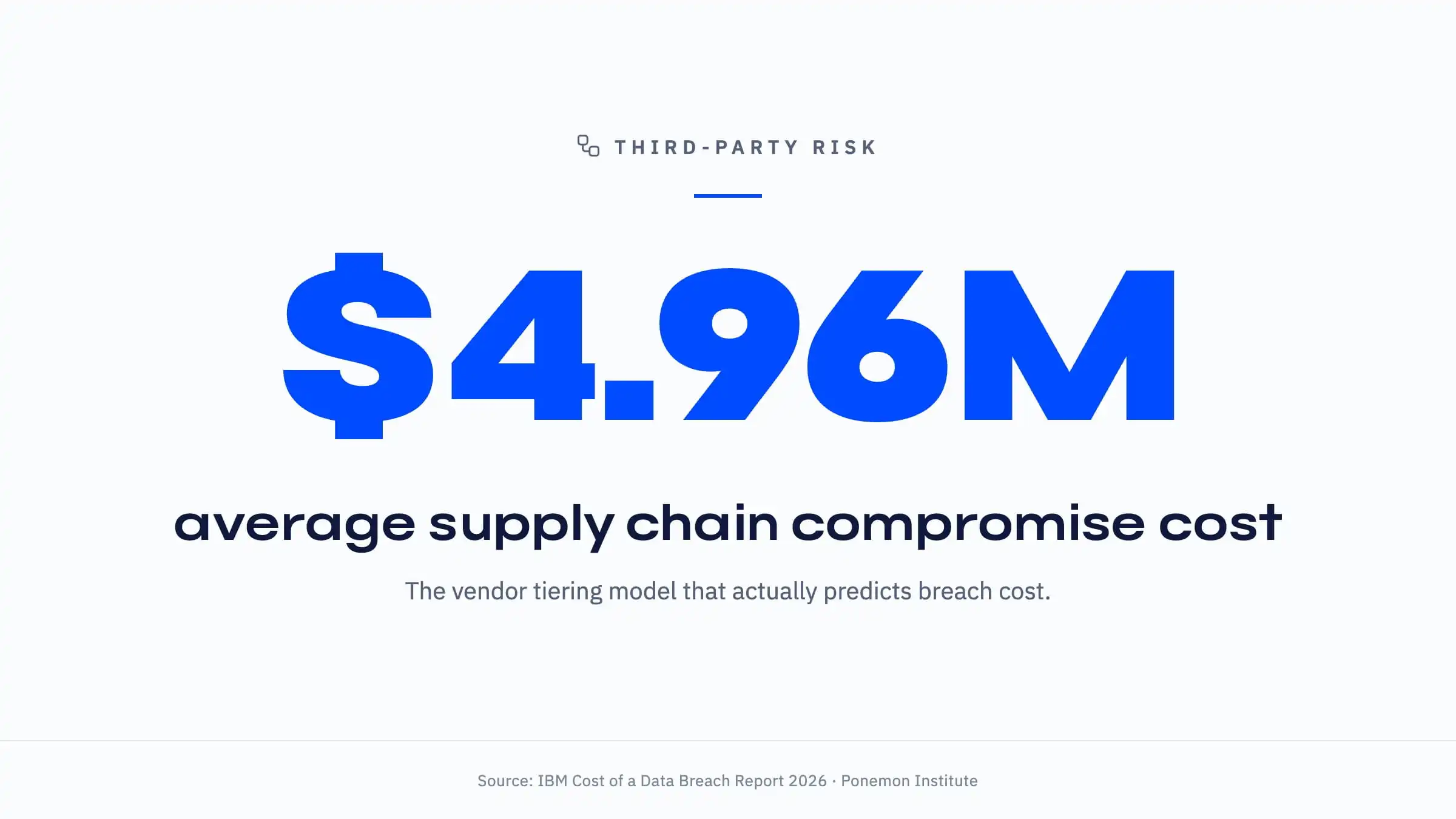
Supply chain compromise, where a business partner's own systems become the way in, is its own well-documented cost driver. IBM's separate analysis of cost-amplifying factors found it added $227,250 to the average breach on its own, the single largest amplifier the report measured. A supply chain compromise and a third-party vendor's AI deployment are the same underlying problem: risk that lives outside the organisation's direct control. A flat, one-size-fits-all vendor list can't flag either one in advance.
Building a vendor tiering model that holds up
A tiering model sorts vendors into risk categories: commonly critical, high, medium and low. Assessment depth, review frequency and monitoring intensity all scale with the actual exposure a vendor represents. That's the variable that sets the tier, independent of alphabetical order or contract size.
What actually separates a critical vendor from a low-risk one
A practical tiering model rests on four factors. What the vendor can see or touch matters first: personal data, financial records, credentials and source code carry more weight than access to nothing of consequence. What happens operationally if the vendor goes down for a day, a week, or longer matters just as much. So does whether the vendor's failure creates a compliance obligation of its own: a breach notification duty, an audit finding, a contractual penalty.
Deployment model belongs on that list too. How and where a vendor delivers its service correlates with cost, and IBM's evidence above backs that up. That correlation earns deployment model a place alongside data access and business dependency.
This approach has deep roots. NIST SP 800-161 (the US National Institute of Standards and Technology's Cybersecurity Supply Chain Risk Management Practices for Systems and Organizations) has for years directed organisations to tailor risk management to a supplier's criticality. What's changed is the cost data now available to justify spending assessment time where it actually matters, turning the exercise into a resourcing decision instead of a compliance formality.
Why a one-time assessment goes stale
A tier assigned at onboarding and never revisited is a snapshot that goes stale. Vendors change what data they access, add subcontractors, get acquired, or expand into new parts of the business relationship. Any of that can shift a vendor from one tier to another. A tiering model earns its keep only when review frequency is itself tied to tier: critical vendors reassessed on a defined cycle, low-risk vendors checked less often on a cycle that still keeps them in view.
That's a monitoring problem as much as an assessment one, and it's where most manual TPRM programmes run out of capacity. Reviewing every vendor on the same schedule wastes effort on the low-risk end and under-serves the critical one.
Turning tiers into something GRC teams can act on
SureCloud's third-party risk management capability lets teams track vendor contract terms and review dates, assign criticality tiers and score risk in one connected record. A spreadsheet is accurate the day it's built and stale a quarter later; a connected record stays current. Gracie AI Agents with Personas and Skills reasons across vendor, risk and control data together, surfacing which vendors sit in which tier, what evidence is missing and which reviews are overdue.
SureCloud's Vendor Risk Tiering Toolkit (landing page in progress) extends this into a practical starting framework for teams building or rebuilding a tiering model from scratch.
Teams using SureCloud's connected approach to risk data report up to 50-65% reduction in manual evidence collection. That turns vendor reviews from a document-chasing exercise into something a small team can keep current across a large vendor list. SureCloud's third-party risk resource hub covers the practical mechanics of building this out, from initial assessment through ongoing oversight.
None of this replaces judgment. A tiering model narrows down where that judgment gets applied first.
Found this useful?
Choose SureCloud as a preferred source in Google and you will see more of our GRC guidance in Top Stories, AI Overviews and AI Mode. It takes one click and you can undo it at any time.
Let Gracie get the work done.
Gracie drafts summaries, evidence requests and audit narratives across your programme — you stay in control.
See Gracie in action or book a full platform demo →See what SureCloud costs
A short form, no sales call. Pricing built around your GRC estate.
Get PricingIDC names SureCloud the industry's first cross-domain agentic GRC platform
Read the independent analyst view on how SureCloud is redefining risk and compliance.
Download for free