ISO 27001 Compliance Software
Certification Without Complexity: ISO 27001 Made Easy
ISO 27001: The Global Standard for Information Security Management
Published jointly by the International Organisation for Standardisation (ISO) and the International Electrotechnical Commission (IEC), it specifies the requirements for establishing, implementing, maintaining, and continually improving a structured approach to protecting sensitive information.
The standard does not prescribe a fixed list of technical controls. Instead, it requires organisations to identify their information security risks and select appropriate controls to manage them. Annex A of ISO/IEC 27001:2022 provides a reference set of 93 controls across four themes — organisational, people, physical, and technological — from which organisations select based on their own risk assessment and document in a Statement of Applicability (SoA).
ISO 27001 applies to organisations of all sizes and sectors. Certification is awarded by an accredited third-party certification body following a two-stage audit process, and must be maintained through annual surveillance audits and full recertification every three years.
| Key Facts |
|
| Governing body | ISO/IEC (International Organisation for Standardisation / International Electrotechnical Commission) |
| Applies to | All organisations, regardless of size, sector, or geography |
| Certification required | Yes — issued by accredited third-party certification bodies (e.g. BSI, LRQA, Bureau Veritas) |
| Audit frequency | Annual surveillance audits; full recertification every 3 years |
| Latest version | ISO/IEC 27001:2022 (published October 2022; transition deadline for 2013-certified organisations was October 2025) |
ISO 27001 Certification Doesn't Just Reduce Risk. It Wins Business.
It opens procurement doors.
It gives auditors and customers evidence, not promises.
It reduces your breach exposure — systematically.
It shortens due diligence cycles.

How SureCloud Supports ISO 27001 Compliance
One Platform. Every Requirement. No Spreadsheets.
SureCloud's Risk Management product maps directly to ISO 27001's risk assessment and treatment requirements. Build a structured risk register, assess threats and vulnerabilities against your assets, document your treatment decisions, and maintain a live Statement of Applicability — all within a single controlled environment. Risk owners are assigned, review cycles are tracked, and nothing falls through the gap between audits.
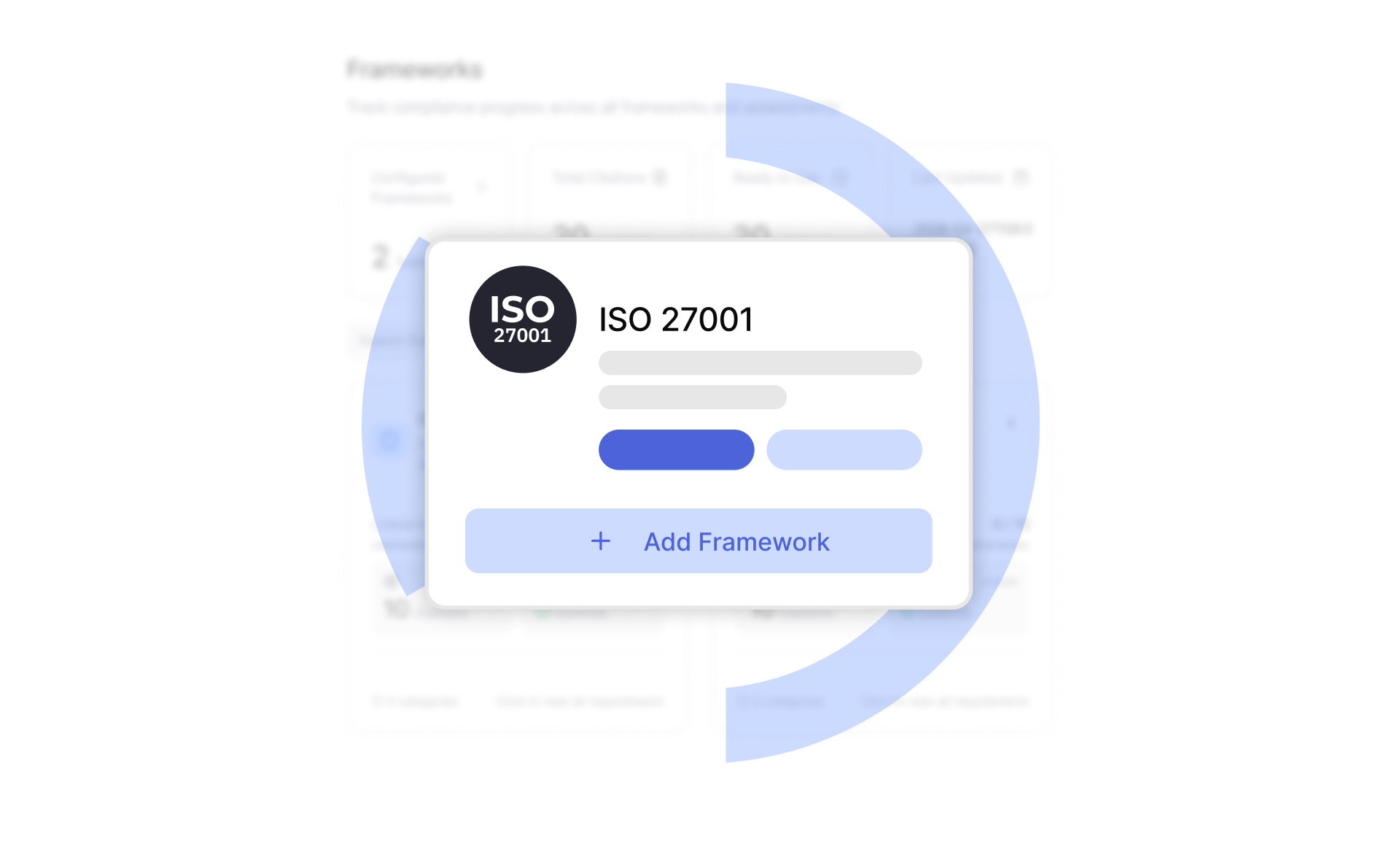
SureCloud's Compliance Management product includes a pre-mapped ISO/IEC 27001:2022 control set, giving your team a ready-to-use starting point rather than building a framework from scratch. Assign control owners, define review cadences, and track implementation status across every Annex A domain from a single compliance dashboard. When a new version of the standard is released, your framework updates without starting over.

Continuous Control Monitoring (CCM) automatically collects evidence against your controls on an ongoing basis — not just in the weeks before an audit. When your external auditor requests proof of control operation, it is already captured, dated, and traceable. Manual evidence gathering before surveillance audits becomes a fraction of the effort.

ISO 27001 explicitly requires organisations to manage information security risks within their supply chain. SureCloud's Third-Party Risk Management (TPRM) product lets you assess vendors, track their control and compliance status, issue and manage questionnaires, and flag gaps — with full traceability back to your ISMS scope and Annex A obligations.
The Core Requirements: What ISO 27001 Actually Asks of Your Organisation
ISO 27001 is a management system standard, not a fixed technical checklist. What you implement depends on your risks — but the structure below applies to every organisation seeking certification.
The two most commonly underestimated requirements — covered in detail here:
ISO 27001 Annex A.8: Technological Controls Guide
ISO 27001 Statement of Applicability: Build One That Stays True
Frequently Asked ISO:27001 Questions
What is ISO 27001?
ISO 27001 is the internationally recognised standard for Information Security Management Systems (ISMS). Published by ISO and IEC, it defines the requirements for identifying information security risks and implementing controls to manage them. Certification is awarded by an accredited third-party body after a two-stage audit and must be maintained through annual surveillance and three-yearly recertification.
What is the difference between ISO 27001 and ISO 27002?
ISO 27001 is the certifiable management system standard — it defines what your organisation must do to establish and maintain an effective ISMS. ISO 27002 provides detailed implementation guidance for the 93 controls listed in ISO 27001's Annex A. Organisations get certified against ISO 27001; ISO 27002 is the supporting reference used when designing and implementing those controls.
How long does ISO 27001 certification take?
Most organisations take between three and twelve months to achieve ISO 27001 certification for the first time. The timeline depends on your starting security maturity, available internal resource, and the complexity of your ISMS scope. Organisations with existing risk management processes and structured compliance tooling in place typically reach certification faster than those starting from scratch. Read more about how long a ISO27001 certificate takes here.
What is a Statement of Applicability?
A Statement of Applicability (SoA) is a mandatory ISO 27001 document that lists all 93 Annex A controls and records whether each applies to your organisation, whether it has been implemented, and the justification for any inclusions or exclusions. The SoA is a key document reviewed by your external auditor during both Stage 1 and Stage 2 of the certification audit.
What happens during an ISO 27001 audit?
ISO 27001 certification involves a two-stage audit by an accredited certification body. Stage 1 reviews your ISMS documentation and design to confirm readiness. Stage 2 assesses whether your controls are operating effectively in practice, tested against real evidence from your day-to-day operations. After certification, annual surveillance audits check ongoing compliance, and a full recertification audit is required every three years.
How does software help with ISO 27001 compliance?
ISO 27001 compliance involves managing a large, interconnected set of risks, controls, policies, owners, and evidence. Without dedicated software, organisations rely on spreadsheets and shared drives that create version control issues, evidence gaps, and audit panic. Compliance software centralises the entire programme, automates evidence collection, assigns accountability, and maintains audit-ready documentation year-round — making ISO 27001 sustainable, not just achievable.
Related ISO 27001 Resources
4.5 out of 5
"Excellent support team"We've been happy with the product and the support and communication has been excellent throughout the migration and onboarding process.
Posted on
G2 - SureCloud
5 out of 5
"Great customer support"
The SureCloud team can't do enough to ensure that the software meets our organisation's requirements.
Posted on
G2 - SureCloud
4.5 out of 5
"Solid core product with friendly support team"
We use SureCloud for Risk Management and Control Compliance. The core product is strong, especially in validating data as it is...
Posted on
G2 - SureCloud
5 out of 5
"Excellent GRC tooling and professional service"
We've been happy with the product and the support and communication has been excellent throughout the migration and onboarding process.
Posted on
G2 - SureCloud
4.5 out of 5
"Straightforward Implementation, Intuitive Use, and Brilliant Support"
SureCloud has been straightforward to implement and tailor to our framework. It’s intuitive to use, so our teams have adopted it quickly...
Posted on
G2 - SureCloud
5 out of 5
"Easy to Use, Beautiful Graphs, and a Helpful, Responsive Team"
Very easy to use and really nice graphs are created. The team are also very helpful and quick to respond
Posted on
G2 - SureCloud