Compliance Management
 Risk Management
 Third Party Risk Management
 Data Privacy Management
 Internal Auditing
 Business Continuity Management
 Continuous Control Monitoring (CCM)
 Trust Center
 AI Governance
- Data Privacy
- 1st Sep 2026
- 1 min read
Healthcare Data Breach Cost 2026: $6.64M

- Written by
In Short..
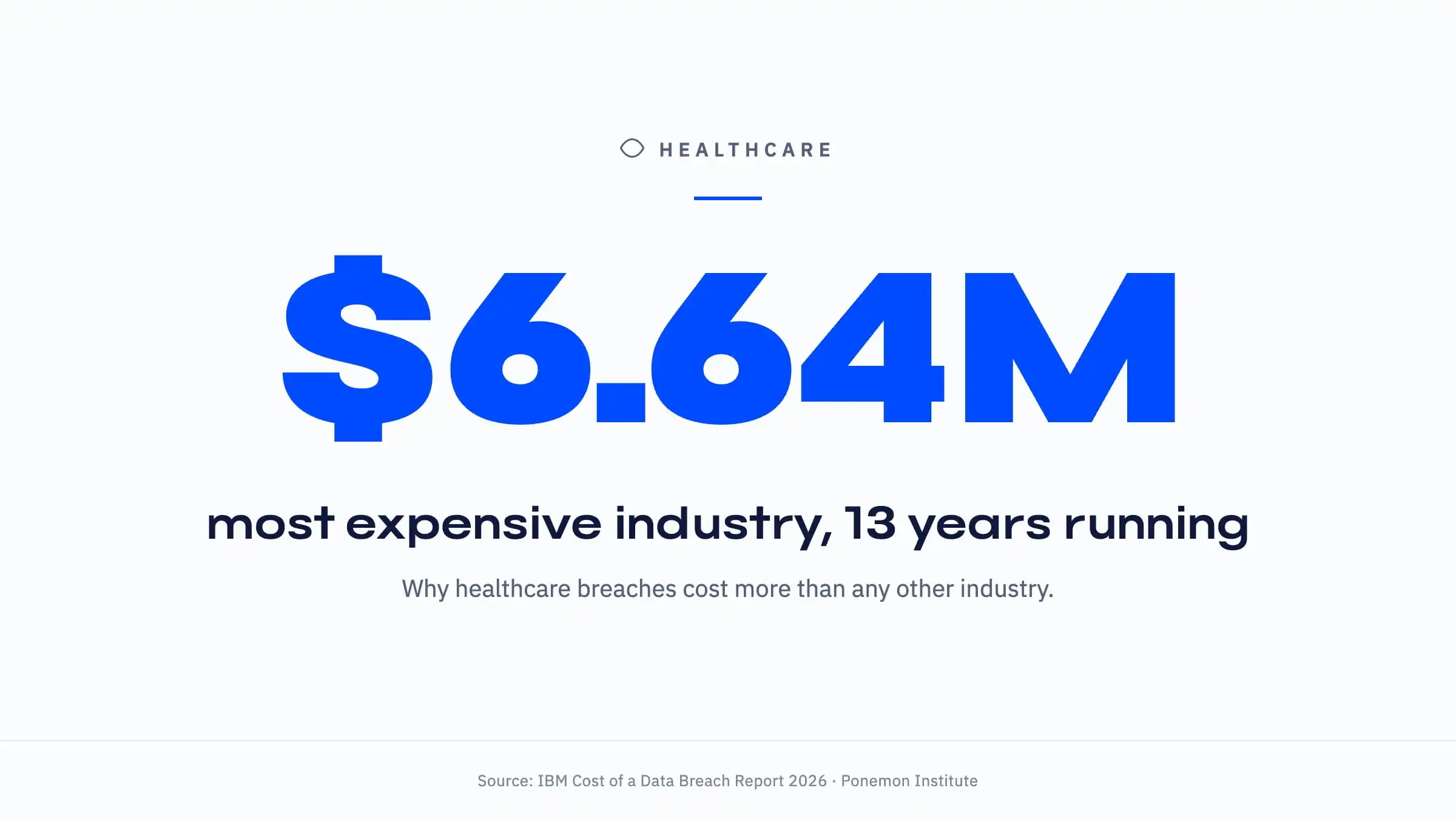
- Healthcare improved and still led: Average cost fell 10.5% to $6.64 million, yet healthcare stayed the most expensive industry for a 13th straight year, $1.65 million above the $4.99 million global average.
- Improvement and exposure are different questions: The 10.5% drop shows progress; the $1.65 million gap shows how much distance is left. Both are true at once.
- The structural conditions haven't shifted: Safety-critical operations, sensitive patient data, interconnected clinical systems, legacy devices and dense supplier networks keep incidents hard to contain regardless of year-on-year improvement.
- Attacks are more often malicious here too: 59% of healthcare breaches involved a malicious or criminal attack this year, above the 55% average across all industries IBM measured.
Healthcare breaches cost an average of $6.64 million in 2026, down 10.5% from $7.42 million the previous year, a drop also reported by HIPAA Journal's coverage of the report. That's meaningful progress: down $780,000 in a single year. Yet healthcare remained the most expensive industry in the IBM Cost of a Data Breach Report 2026, produced by IBM and the Ponemon Institute, for the 13th consecutive year (pp.10-13), the finding Paubox led its own coverage with, still $1.65 million above the $4.99 million global average breach cost.
Those two facts, the improvement and the ranking, sit together without contradiction, because they measure different things.
Expert View

Matt Davies Chief Product Officer, SureCloud |
What our experts say about why healthcare incidents stay costly
"Healthcare incident response teams spend the first several hours simply figuring out which systems and suppliers actually connect to the affected one. That's fundamentally a mapping problem, and closing it before an incident happens is the single biggest lever we see healthcare teams pull to cut response time." |
A meaningful improvement that did not change the ranking
The move from $7.42 million to $6.64 million is a 10.5% reduction year on year, a significant sum recovered in absolute terms. For organisations that have invested in breach preparedness, response capability or risk controls, it's a signal the work is having an effect.
At the same time, the global average breach cost rose 12% over the same period, reaching $4.99 million (pp.10-11). Healthcare's improvement happened inside a moving environment: every other sector in IBM's analysis was moving too, mostly upward.
Two questions, two different answers
Board-level conversations about breach cost tend to blend two distinct questions worth separating: whether the organisation is improving, which the 10.5% year-on-year reduction answers on its own, and how large the remaining exposure is, which the $1.65 million gap between healthcare's average and the global figure answers instead. That gap shows how much further the journey has to go, even as the trend moves in the right direction.
Healthcare can improve every year and still lead IBM's cost rankings if the conditions that make its incidents expensive haven't shifted. Thirteen consecutive years at the top says exactly that.
Why healthcare's breach-cost floor stays high
IBM's data establishes that healthcare has ranked first in breach cost for 13 consecutive years. The report records the outcome; the reasons behind it call for sector-level reasoning drawn from how healthcare organisations operate.
IBM reports healthcare as its own industry category, defined as hospitals and clinics, separate from the broader critical national infrastructure (CNI) grouping. Healthcare connects to the wider CNI conversation because disruption to patient-facing services carries direct real-world consequences, a material difference from sectors where downtime is mainly a financial or reputational event.
Conditions that make healthcare incidents hard to manage
Several characteristics of the healthcare environment tend to make incidents harder to contain and more costly to resolve. These are general sector observations, not IBM's own stated explanation for the $6.64 million figure:
|
Factor |
Why it matters in an incident |
|
Safety-critical service availability |
Clinical operations can't simply pause during an investigation; continuity demands run alongside response activity. |
|
Highly sensitive health and personal data |
Patient records carry significant notification, regulatory and reputational weight when compromised. |
|
Interconnected clinical and administrative systems |
A breach in one environment can spread across patient management, billing and operational platforms at once. |
|
Medical devices and legacy infrastructure |
Many clinical environments include devices that can't be patched or isolated quickly, extending containment timelines. |
|
Third-party and supplier dependencies |
Diagnostic, pharmaceutical and technology suppliers integrate into clinical workflows, widening the potential impact surface. |
IBM's data backs this with a harder number: malicious or criminal attacks accounted for 59% of healthcare breaches this year, above the 55% average across all industries IBM studied.
None of these factors make a costly outcome certain. Organisations that invest in understanding these dependencies and maintaining clear visibility across them are better placed to manage incidents when they happen. The conditions that make healthcare incidents expensive are structural, and they've held steady for over a decade.
Why incident response alone is not enough
Better incident response matters: faster containment, clearer escalation paths and well-rehearsed recovery procedures all help reduce the cost and duration of a breach. IBM's data records that the average cost fell 10.5%; it doesn't establish exactly what caused that drop. The improvement may reflect better response capability, changes in breach type or scope, or shifts in reporting patterns across the sample.
What thirteen years of the same ranking does suggest is that response capability alone hasn't moved healthcare out of first place.
Looking upstream of the incident
The structural conditions described above run in the background long before any breach is detected: complex supplier relationships, interconnected systems, legacy infrastructure, and sensitive data flows spanning clinical and administrative environments.
Healthcare leaders focused only on incident response are addressing the point where cost has already started accumulating. The more useful question is what conditions made the incident hard to manage in the first place, and whether the organisation could have understood those conditions earlier.
Better visibility doesn't prevent every incident. The practical case is narrower: reducing avoidable friction in identifying impact, prioritising action and communicating decisions during an incident is itself a meaningful cost lever.
Fragmented operational data is what turns a healthcare incident into an expensive one
When teams can't quickly answer where affected systems connect, which suppliers are involved, or what the clinical impact is, response time stretches, and every extra hour in a complex environment adds cost. |
Addressing that friction calls for visibility into operational, technology and supplier risk before issues escalate, alongside a well-rehearsed response plan for after they do.
Closing the visibility gap behind the cost
When a healthcare incident happens, the teams managing it need to understand what occurred across clinical, administrative, technology and supplier environments at the same time. That spans risk registers, third-party records, asset inventories, control logs and incident data that, in many organisations, live in separate tools or spreadsheets.
Fragmented data slows more than root-cause investigation. It slows every decision that follows: which systems to isolate, which suppliers to notify, which executives to brief, and what to tell the board.
Bringing risk data into one view
SureCloud brings operational and technology risk data into a single connected view, helping teams investigate root causes, prioritise action and prepare decision-ready reporting without reconciling information across disconnected sources. Gracie AI Agents with Personas and Skills surfaces the connections between affected systems, suppliers and controls automatically, so that picture forms in minutes rather than days.
Teams using this approach report up to 75% faster time to insight through a single source of truth, board-report preparation cut from two weeks to two days, and up to 40% faster decision-making with real-time unified risk data. These figures reflect general platform performance across risk and technology teams; they aren't healthcare-specific results.
In a high-stakes incident, cutting board-reporting preparation from two weeks to two days changes what leadership decides on: current information instead of a stale snapshot.
SureCloud's healthcare and life sciences platform supports connected risk management across operational and technology domains, giving healthcare teams the unified visibility they need to act on what matters.
The practical goal
Healthcare doesn't need to wait until it stops being the highest-cost industry to make progress. The 10.5% reduction in average breach cost shows progress is already happening.
The more durable objective is reducing the avoidable operational burden that makes high-stakes incidents more expensive than they need to be: better visibility of risk before incidents escalate, faster root-cause understanding when they happen, and more connected decision-making throughout. Becker's Hospital Review covered the 13-year run prominently in its own report coverage, and Paubox led with it as the headline; it's the finding worth acting on.
Thirteen years of the same ranking points past incident response, toward the conditions that drive the cost in the first place, the more durable place to intervene.
Found this useful?
Choose SureCloud as a preferred source in Google and you will see more of our GRC guidance in Top Stories, AI Overviews and AI Mode. It takes one click and you can undo it at any time.
Let Gracie get the work done.
Gracie drafts summaries, evidence requests and audit narratives across your programme — you stay in control.
See Gracie in action or book a full platform demo →See what SureCloud costs
A short form, no sales call. Pricing built around your GRC estate.
Get PricingIDC names SureCloud the industry's first cross-domain agentic GRC platform
Read the independent analyst view on how SureCloud is redefining risk and compliance.
Download for free