Compliance Management
 Risk Management
 Third Party Risk Management
 Data Privacy Management
 Internal Auditing
 Business Continuity Management
 Continuous Control Monitoring (CCM)
 Trust Center
 AI Governance
- Data Privacy
- AI Governance
- 2nd Sep 2026
- 1 min read
Shadow AI Data Breach Cost 2026: $5.39M

- Written by
In Short..
- Shadow AI is common now: It featured in 43% of security incidents in IBM's 2026 research, up from 20% a year earlier, more than doubling in twelve months.
- The incidents are getting costlier too: Average cost for shadow AI-involved breaches rose to $5.39 million in 2026 from $4.63 million in 2025, a $760,000 year-on-year increase.
- The fallout spreads across the whole business: Reported consequences include data loss (49%), operational disruption (42%), reputational damage (35%), higher security costs (32%) and regulatory fines (21%), often overlapping in a single incident.
- Governance controls moved the wrong way: Even as shadow AI risk grew, the share of organisations requiring IT approval for AI deployments fell from 45% to 38%, and only 19% coordinate AI governance with security.
Shadow AI refers to AI tools staff use without formal sign-off. It showed up in 43% of security incidents in the IBM Cost of a Data Breach Report 2026 this year, more than double last year's 20% (printed p.45).
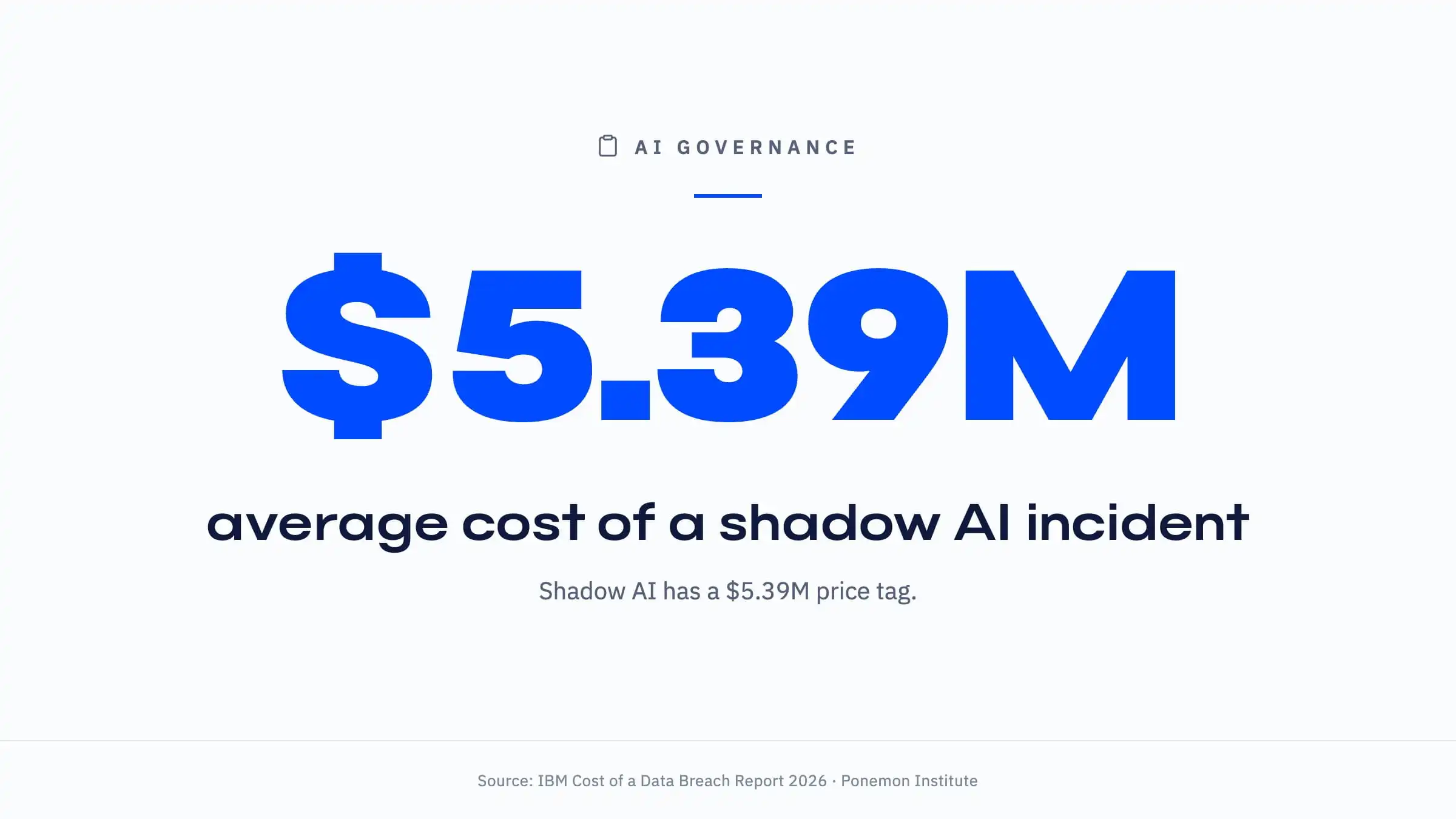
The incidents got more expensive too. Breaches involving shadow AI averaged $5.39 million this year, up $760,000 from $4.63 million last year. Both numbers are moving the same direction, and that's what has put unapproved AI use on the board's agenda.
Expert View

Matt Davies Chief Product Officer, SureCloud |
What our experts say about closing the shadow AI visibility gap
"Every shadow AI conversation starts the same way: a security team confident in its policy, with no answer for how many AI tools are touching company data. That gap between policy and reality is where the risk sits. The fix is a live inventory with a named, accountable owner." |
Shadow AI has stopped being a marginal risk
The IBM Cost of a Data Breach Report 2026, produced with the Ponemon Institute, gives shadow AI dedicated analysis for the first time this year (printed p.45). Earlier editions didn't break shadow AI out as its own category, so this is the first real baseline for how common it's become and what it costs. Forkast's coverage of the report states the same figures in its own reporting.
Prevalence alone would justify attention. IBM's cost data adds weight to it.
What last year's number is actually measuring
The $5.39 million figure comes from comparing this year's shadow AI-involved incidents with last year's $4.63 million, the same category of incident measured twelve months apart. IBM treats the $760,000 rise as a pattern drawn from its dataset, a directional signal about aggregate risk. Any single organisation's actual number will depend on its own circumstances.
Security and risk leaders can act on this regardless of how the causation question eventually resolves. Shadow AI showed up in more incidents this year than last, and those incidents cost more when it did.
The consequences spread well beyond security
IBM's research also breaks down what these incidents produce. The consequence mix, where more than one outcome can apply to a single incident, spans five categories (printed p.45):
|
Reported consequence |
Share of shadow AI incidents (2026) |
|
Data loss or compromise |
49% |
|
Operational disruption |
42% |
|
Reputational damage |
35% |
|
Increased security costs |
32% |
|
Regulatory fines paid |
21% |
IBM treats these as overlapping categories, several outcomes often applying to the same incident, which is why the figures add up to more than 100%. Read together, they show a risk profile touching data protection, operational continuity, brand trust, security budget and regulatory exposure all at once.
Data loss carries GDPR (the EU's General Data Protection Regulation) notification obligations, and operational disruption feeds straight into resilience planning that carries its own reporting duties for firms in scope of DORA (the EU's Digital Operational Resilience Act) or NIS2 (the EU's Network and Information Security Directive). The rest land on the board regardless. Reputational damage and regulatory fines are board-level by their nature, and a rise in security costs means a budget conversation that needs executive sign-off, wherever the money first came from.
Governance controls are moving the wrong way
Governance hasn't kept pace with shadow AI's growth, and by some measures it's actually weakened, which should worry security and risk leaders more than the headline cost figure. Among breached organisations, 68% lacked AI governance capable of managing AI use or detecting shadow AI this year, up from 63% the year before (printed p.46).
Cybersecurity Dive's own reading of the report reached the same conclusion. More than two-thirds of organisations lacked governance processes to limit shadow AI. Adoption is accelerating while oversight is losing ground.
The mechanics behind that gap are visible in IBM's own data on governance controls. The most common technical safeguard, requiring IT approval before an AI tool goes live, was used by 38% of organisations enforcing AI governance this year, down from 45% the year before (printed p.47). And coordination between the teams best placed to catch shadow AI early, governance and security, happened at only 19% of organisations (printed p.47).
Required approval is down. Cross-team coordination is rare. Incidents are up. The three move together.
That's the gap only a governed register can close.
Why a policy on its own falls short
An AI governance policy earns its place. It sets the rules, defines what's permitted and gives employees a clear reference point for what the organisation expects, and that groundwork holds up.
A written AI governance policy delivers a rulebook. It defines what's permitted and gives employees a clear reference point. Turning that rulebook into an accurate picture of what's actually running takes a different discipline: an inventory.
The inventory tracks which AI tools are live across the business, what data each one touches, and which providers can reach information the policy assumes stays internal. Building it means gathering ongoing evidence from exactly the places shadow AI does its damage.
Closing that space is a visibility problem, and visibility needs a different kind of fix.
From policy to a governed register
Closing the gap starts with an AI use case and model register, a structured, maintained record of every AI tool in use, who's accountable for it, what data it touches and what risk classification applies. The register is what turns the policy from a stated intention into something you can actually check against, backed by real evidence.
Building that register means finding the AI tools and providers already in use, including the ones nobody signed off on, then giving each one a proportionate risk classification and a named, accountable owner. It also means keeping documented evidence, assessments and incident records that hold up when a regulator, auditor or board asks the obvious question.
The question of exactly who should own AI governance inside a specific organisation is a separate one, worth answering deliberately. What matters for shadow AI specifically is ownership at the level of each individual use case, sitting underneath the policy document that's supposed to govern all of them. That's what gives the policy something concrete to point to.
Standards give the register somewhere to point
For organisations building toward a structured AI management framework, ISO/IEC 42001:2023 is the recognised reference point for AI management systems. SureCloud Compliance Management supports ISO/IEC 42001:2023 alongside other compliance frameworks. Certification demonstrates that AI governance operates as a managed, ongoing discipline, even though incidents can still happen at any level of maturity.
A use case discovered through a shadow AI review should meet the same bar as one that was sanctioned from day one. The distinction between the two matters for remediation, and the standard each is eventually held to stays the same either way.
It reaches further than IT
AI risk rarely sits in isolation. A model handling personal data carries data protection implications, and a use case touching a regulated process brings compliance implications with it. An AI tool adopted by a supplier brings third-party risk management into the conversation alongside security.
A register that lives inside the broader GRC (governance, risk, and compliance) programme keeps those connections visible in one place a governance team can see and act on.
What good visibility replaces
SureCloud brings AI risk into the same connected view as the rest of an organisation's risk and compliance data. Gracie AI Agents with Personas and Skills surfaces the connections between discovered AI use cases, the data they touch and the controls that apply, so that picture stays current inside a governed register, built before an incident forces the question.
SureCloud customers report up to 40% faster decision-making once risk data is unified and available in real time, turning a shadow AI review from a multi-week reconstruction exercise into something a governance team can keep current. The 40% figure is a general platform result across risk and compliance teams, unrelated to shadow AI specifically.
What the board needs is a current, honest answer to a simple question: which AI is running across this organisation right now, and who's accountable for it.
Found this useful?
Choose SureCloud as a preferred source in Google and you will see more of our GRC guidance in Top Stories, AI Overviews and AI Mode. It takes one click and you can undo it at any time.
Let Gracie get the work done.
Gracie drafts summaries, evidence requests and audit narratives across your programme — you stay in control.
See Gracie in action or book a full platform demo →See what SureCloud costs
A short form, no sales call. Pricing built around your GRC estate.
Get PricingIDC names SureCloud the industry's first cross-domain agentic GRC platform
Read the independent analyst view on how SureCloud is redefining risk and compliance.
Download for free