Compliance Management
 Risk Management
 Third Party Risk Management
 Data Privacy Management
 Internal Auditing
 Business Continuity Management
 Continuous Control Monitoring (CCM)
 Trust Center
 AI Governance
- Data Privacy
- 3rd Sep 2026
- 1 min read
Non-Human Identities: Your AI Stack's Blind Spot

- Written by
In Short..
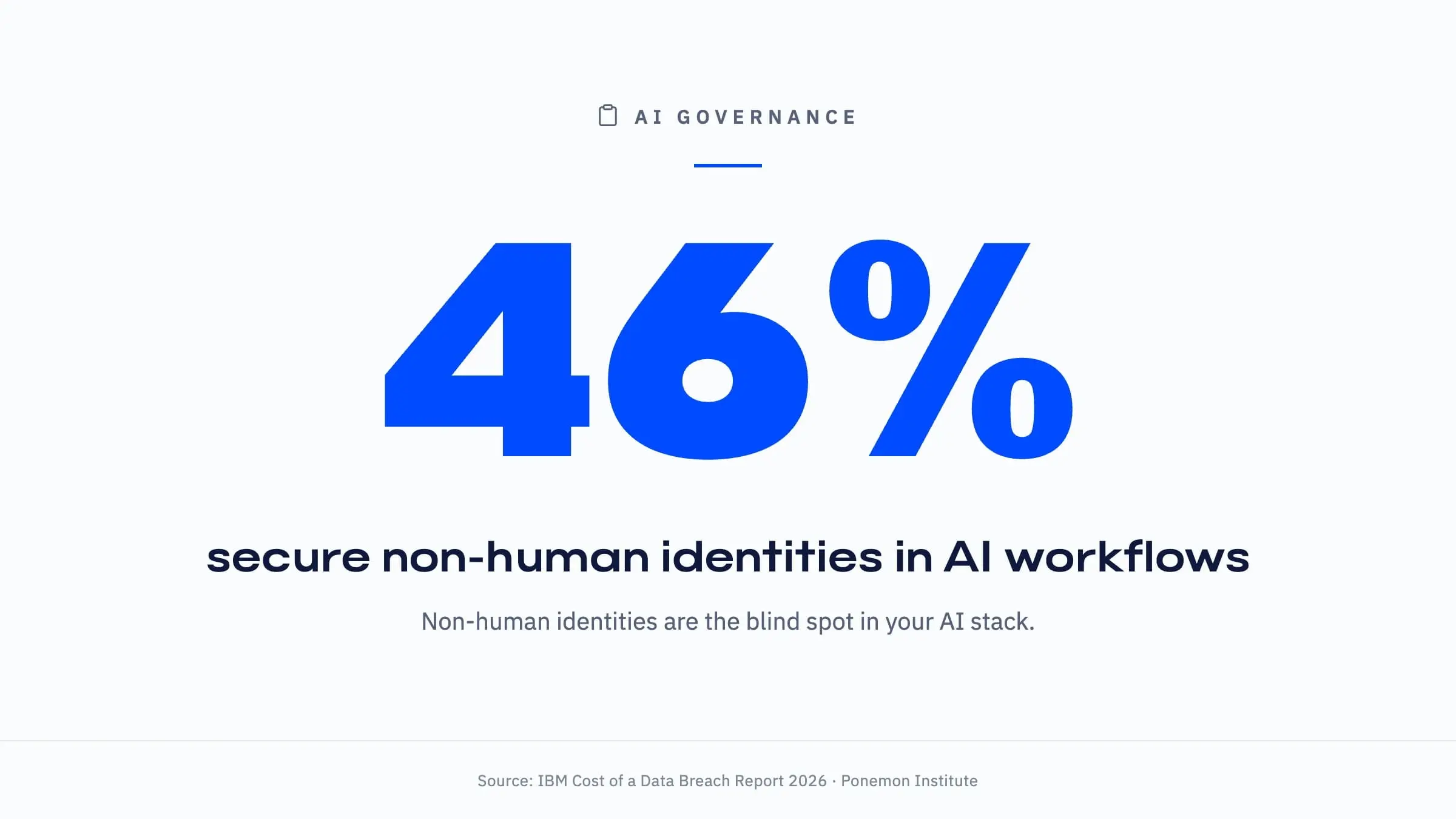
- Non-human identities are now a majority-unmanaged attack surface: Only 46% of organisations report securing NHIs in their AI workflows, leaving the majority of service accounts, API keys and AI agents outside formal security controls.
- Access-control gaps are driving AI breaches, more than attacker sophistication: 92% of organisations with an AI-related breach lacked proper AI access controls, and only 40% of organisations use access controls on AI models and data at all.
- No single control covers most organisations: Among organisations that do secure NHIs, the most common approach, machine identity and lifecycle management, still covers only 55%; the other four approaches IBM tracked each cover under 40%.
- The failure modes are already named and mapped: The OWASP Non-Human Identities Top 10 lists improper offboarding, secret leakage, overprivileged access and long-lived credentials among the risks organisations keep running into.
92% of organisations that suffered an AI-related breach lacked proper AI access controls, according to the IBM Cost of a Data Breach Report 2026. The same report found that fewer than half of organisations, 46%, secure the non-human identities their AI workflows actually run on. That includes the service accounts, API keys and now AI agents that increasingly do the work humans used to do by hand.
Every AI agent an organisation deploys is a new non-human identity. Most governance programmes are still built to track people, leaving the credentials their AI stack quietly accumulates largely out of view.
Expert View

Matt Davies Chief Product Officer, SureCloud |
What our experts say about non-human identity risk
"Every AI agent you deploy is a new non-human identity, and most GRC programmes still don't have a line item for it. IBM's own data backs that up: 92% of AI-related breaches trace back to a missing access control, plain and simple. The fix is treating every agent like the credential it actually is, from day one." |
What counts as a non-human identity, and why the list keeps growing
IBM defines non-human identities (NHIs) as digital credentials assigned to machines, devices and other non-human resources, covering service accounts and API keys as well as the AI agents now proliferating across enterprise workflows. Many organisations actively prefer securing processes this way. An NHI's access doesn't depend on one employee's status or habits, and security teams can track it independently of the team.
That preference has a cost. Every process handed to an NHI is a credential that needs its own lifecycle, its own permissions and its own owner. The number of NHIs in a typical AI stack grows far faster than the number of employees ever did.
Most organisations leave the identities their AI runs on unsecured
IBM's 2026 data puts the figure at 46%, less than half of organisations reporting that they secure NHIs in their AI workflows. Among the organisations that do, machine identity and lifecycle management, automated tracking of service accounts and API keys, is the most common approach at 55%. Secrets management systems follow at 39%, behavioral monitoring at 36%, zero trust extensions to NHIs at 32%, and role-based access controls at 30%.
No single approach reaches even two-thirds of the organisations already taking NHI security seriously. That's why IBM's own researchers frame a multilayered approach as essential, and most organisations haven't reached the first layer of it yet.
The access-control gap is where AI breaches actually happen
Among organisations that experienced an AI-related breach, 92% lacked proper AI access controls. Only 40% of organisations apply access controls to their AI models and data at all, before any breach happens. Identity and access management already ranks among the most effective cost reducers IBM tracks for breaches generally, yet AI-specific access control adoption has fallen well behind AI adoption itself.
The pattern IBM describes doesn't require a sophisticated attacker. The gaps are basic: an AI agent with more access than its task requires, a service account nobody rotated, a credential that outlived the project it was created for. Any one of those gets exploited whether or not the attacker used AI to find it.
The failure modes are already named and mapped
The OWASP Non-Human Identities Top 10 gives GRC teams a ready-made taxonomy for this, built from real breach data, security surveys and vulnerability databases. Its top risks line up closely with IBM's own control gaps: improper offboarding (access that outlives the project or the employee who requested it), secret leakage, overprivileged NHIs, long-lived secrets that are never rotated or expired, and insecure authentication.
Each OWASP risk maps to one of IBM's own control categories. Lifecycle management addresses improper offboarding directly, and secrets management systems target secret leakage and long-lived credentials.
Role-based access controls exist specifically to prevent overprivileged NHIs. The two frameworks agree closely on what the problem looks like; the gap sitting between them is adoption.
Treating every agent like the credential it actually is
SureCloud's own AI governance capability builds a register of every AI use case across the business. That register discipline is what keeps a new AI agent from quietly becoming an unmanaged NHI the moment it goes live. Gracie AI Agents with Personas and Skills is itself built on that principle: its permissions are inherited from the active user, never assumed, and every action it takes is logged as an immutable, explainable record.
That's the same standard IBM's data suggests most organisations aren't holding their other AI agents to. The FCA alone fined UK firms £176 million in 2024, a reminder that an unmanaged NHI carries a governance cost with a real number attached, alongside the technical one.
SureCloud's agentic AI in GRC resource hub covers the wider governance question this raises, including where agentic AI can safely take on compliance work and where human review still belongs.
Found this useful?
Choose SureCloud as a preferred source in Google and you will see more of our GRC guidance in Top Stories, AI Overviews and AI Mode. It takes one click and you can undo it at any time.
Let Gracie get the work done.
Gracie drafts summaries, evidence requests and audit narratives across your programme — you stay in control.
See Gracie in action or book a full platform demo →See what SureCloud costs
A short form, no sales call. Pricing built around your GRC estate.
Get PricingIDC names SureCloud the industry's first cross-domain agentic GRC platform
Read the independent analyst view on how SureCloud is redefining risk and compliance.
Download for free