Last reviewed: 27th October 2026
NIS2 compliance software for critical infrastructure and manufacturers
SureCloud's NIS2 compliance software helps critical infrastructure operators and manufacturers meet their NIS2 obligations. NIS2 sits in your organisation hierarchy as a regulation, and each risk assessment, policy, supplier review, control and incident record you create links to it. Reports and an audit trail then evidence adherence. The mapped control framework fully supports NCSC CAF v4.0.
NCSC CAF v4.0: mapped and fully supported
The NCSC Cyber Assessment Framework (CAF) helps organisations that run essential services, in sectors such as energy, healthcare, transport, digital infrastructure and government, assess and improve their cyber security and resilience. The NCSC says nearly all UK cyber regulators now use it. CAF v4.0, released in August 2025, adds four changes: attacker methods and motivations, secure software development and maintenance, security monitoring and threat hunting, and AI-related cyber risk.
SureCloud holds CAF v4.0 in the mapped control framework. That's one control set shared with the other frameworks in that library.
UK and Ireland teams can read the guide to NIS2 and NCSC CAF v4.0 for UK and Ireland firms, see how NIS2 Article 21 and CAF v4.0 compare, and check what changes for CNI teams under both.
What Is the NIS2 Directive?
What it is: NIS2 (Directive (EU) 2022/2555) is the EU law that replaces the 2016 NIS Directive. It entered into force on 16 January 2023, and Member States had to apply their national laws from 18 October 2024. Transposition is still incomplete: in July 2026 the Commission referred Ireland, Spain, France and the Netherlands to the Court of Justice for failing to notify full transposition.
Who it applies to: NIS2 applies to medium-sized and large organisations in 18 sectors, including drinking water, digital infrastructure, public administration and the manufacture of medical devices, electronics, electrical equipment, machinery and vehicles. Large entities in the Annex I sectors, such as energy, transport, banking and health, are essential entities (Article 3), and most other in-scope entities are important entities. Some organisations fall in scope whatever their size, and each entity generally falls under the jurisdiction of the Member State where it is established (Article 26); the five-step scope guide helps you check where you stand.
What it requires: In-scope entities apply the cybersecurity risk-management measures in Article 21, at least ten categories of them. Management bodies approve those measures, oversee them and can be held liable for infringements (Article 20). Significant incidents, those that have caused or can cause severe operational disruption or financial loss or considerable damage to others (Article 23), reach the national CSIRT or competent authority in three stages:
|
Stage |
Deadline |
What it contains |
|---|---|---|
|
Early warning |
Within 24 hours of becoming aware of a significant incident |
Whether unlawful or malicious acts are suspected, and whether the incident could have cross-border impact. |
|
Incident notification |
Within 72 hours of becoming aware |
An update to the early warning, with an initial assessment of severity and impact and, where available, indicators of compromise. |
|
Final report |
No later than one month after the incident notification. If the incident is still ongoing, a progress report comes first and the final report follows within one month of handling it |
A detailed description, the likely root cause, mitigation applied and ongoing, and any cross-border impact. |
|
Field |
Detail |
|---|---|
|
Governing body |
European Union (Directive (EU) 2022/2555), enforced by national competent authorities in each Member State. CSIRTs receive incident notifications, and ENISA supports Member States at EU level. |
|
Applies to |
Essential and important entities across 18 sectors, including energy, transport, banking, health, digital infrastructure, and public administration |
|
Certification required |
No. NIS2 is a legal obligation assessed by national supervisory authorities, not a certifiable standard |
|
Audit frequency |
Essential entities: proactive supervision with regular audits and inspections. Important entities: reactive supervision, triggered by evidence or indications of non-compliance |
|
Latest version/date |
Directive (EU) 2022/2555, in force since 16 January 2023. Member States had to apply national measures from 18 October 2024 |
|
UK position |
NIS2 reaches a UK organisation through an EU establishment (Article 26). UK essential services follow the NIS Regulations 2018, assessed against the NCSC CAF, and the Cyber Security and Resilience Bill would amend those Regulations. |
|
Fines (Article 34) |
Member States must set a maximum fine of at least €10 million or 2% of worldwide annual turnover for essential entities, and at least €7 million or 1.4% for important entities, whichever is higher in each case |
NIS2 and the UK: who is in scope, and what applies instead
NIS2 is EU law, and each entity generally falls under the jurisdiction of the Member State where it is established (Article 26). A UK organisation of a listed type and size with an EU establishment is therefore in scope there; non-EU cloud, data centre, managed service and similar providers that offer services in the EU must appoint an EU representative. A UK organisation with no EU establishment can still face NIS2 requirements through its EU customers' supply chain security measures (Article 21(2)(d)). At home, the NIS Regulations 2018 apply, and regulators assess essential services against the NCSC CAF.
As at 27 October 2026, the Cyber Security and Resilience Bill has completed the House of Commons (16 June 2026). The UK Parliament’s bill page lists the House of Lords report stage on 26 October 2026 and third reading on 2 November 2026. It would amend the NIS Regulations 2018.
What's at Stake If You Don't Get Ahead of NIS2
Fines that hit where it hurts.
Personal accountability for your leadership team.
Procurement doors that stay open.
A defensible position when an incident hits.
How SureCloud helps you meet NIS2: link every activity to the regulation
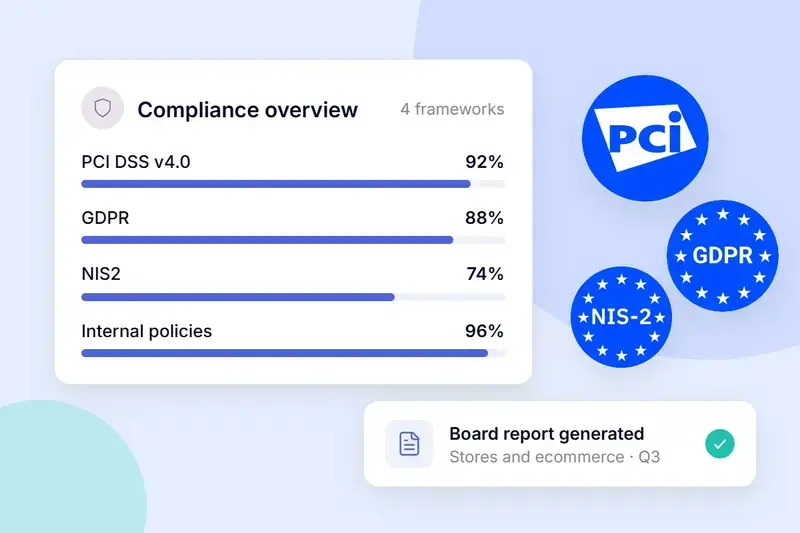
SureCloud delivers NIS2 out of the box as a regulation in your organisation hierarchy, and your activities link to it. Risk assessments, policies, supplier due diligence, controls for encryption and access, incident management, continuity plans and risk reports each link to NIS2, so you can report on NIS2 and keep an audit trail that evidences adherence. You can make those links yourself, or Gracie AI Agents with Personas and Skills can link them, with a person reviewing and signing off the output.
One NIS2 compliance platform. Your activities linked in one workspace.
One workspace holds risks, controls, supplier assessments and incident records, and each block below links its activities to NIS2.
Run the risk analysis Article 21 requires from a single risk register instead of scattered spreadsheets. Score and track cyber risk across IT and OT systems in one place.
See SureCloud's Risk Management Software.
Link controls directly to NIS2's ten minimum measures, report on NIS2 and keep an audit trail that evidences adherence, instead of rebuilding the answer every time a regulator asks.
See SureCloud's Compliance Management Software.

Test control effectiveness continuously, addressing Article 21's requirement to assess risk measures on an ongoing basis rather than once a year.
See SureCloud's Continuous Controls Monitoring Software.

Assess and monitor supplier cybersecurity posture in one workflow, directly addressing NIS2's supply chain security requirement.
See SureCloud's TPRM Software.
The ten Article 21 measures, and the activities that link to each
|
Measure (Article 21(2)) |
What it requires |
Activity that links to it in SureCloud |
|---|---|---|
|
(a) Risk analysis and information system security policies |
Policies on risk analysis and on the security of network and information systems |
Risk assessments and policy management, linked to NIS2 |
|
(b) Incident handling |
A process for handling incidents |
Incident management, linked to NIS2 |
|
(c) Business continuity and crisis management |
[EDITED] Business continuity, such as backup management and disaster recovery, and crisis management |
Continuity planning, linked to NIS2 |
|
(d) Supply chain security |
Security-related aspects of the relationship with each direct supplier or service provider, taking into account each supplier's specific vulnerabilities and cybersecurity practices (Article 21(3)) |
Supplier due diligence in Third-Party Risk Management, linked to NIS2 |
|
(e) Security in acquisition, development and maintenance |
Security when acquiring, developing and maintaining systems, including vulnerability handling and disclosure |
No dedicated activity. General risk and control records can link to NIS2 |
|
(f) Assessing the effectiveness of measures |
Policies and procedures to assess whether your cybersecurity measures work |
Control design and operating tests, and continuous controls monitoring |
|
Measure (Article 21(2)) |
What it requires |
Activity that links to it in SureCloud |
|---|---|---|
|
(g) Cyber hygiene and training |
Basic cyber hygiene practices and cybersecurity training |
No dedicated activity. General policy and control records can link to NIS2 |
|
(h) Cryptography and encryption |
Policies and procedures on the use of cryptography and, where appropriate, encryption |
Controls around encryption, linked to NIS2 |
|
(i) Human resources security, access control and asset management |
HR security, access control policies and asset management |
Controls around identity and access management, linked to NIS2. HR security and asset management have no dedicated activity; general controls can link to NIS2 |
|
(j) Authentication and secured communications |
Multi-factor or continuous authentication, secured voice, video and text communications, and secured emergency communications, where appropriate |
Controls around identity and access management, which can include multi-factor authentication. Secured communications have no dedicated activity; general controls can cover them |
|
Management body accountability (Article 20) |
Management bodies approve the measures, oversee them, follow cybersecurity training and can be held liable for infringements |
Risk reporting for the management body, linked to NIS2 |
What to look for in NIS2 compliance software
Use these ten questions with any vendor. The right-hand column shows how SureCloud answers each, and the guide to vetting NIS2 compliance software goes deeper on how to choose, and it's a useful read before you shortlist.
Framework coverage
1. NIS2 coverage
- Ask: Does the platform hold NIS2 as a regulation your activities link to, or as a checklist?
- Why it matters: How a platform represents NIS2 decides how much evidence your team assembles by hand.
- SureCloud: NIS2 ships out of the box as a regulation your activities link to.
2. NCSC CAF v4.0
- Ask: Does the platform hold CAF v4.0 in its mapped control set?
- Why it matters: UK regulators assess essential services against the CAF.
- SureCloud: The mapped control framework holds NCSC CAF v4.0.
3. One control set
- Ask: Which frameworks share one control set?
- Why it matters: The same controls can support several frameworks.
- SureCloud: One mapped control framework holds CAF v4.0, ISO 27001 and other frameworks, and your NIS2 activities link to it.
Article 21 risk management measures
4. Risk analysis in one place
- Ask: Do IT, cyber and operational risk sit in one place?
- Why it matters: Article 21(2)(a) asks for risk analysis policies.
- SureCloud: Risk Management holds IT, cyber, operational and enterprise risk in one place.
5. Supplier due diligence
-
Ask: Does supplier assessment sit alongside risk and controls?
-
Why it matters: Article 21(2)(d) covers each direct supplier.
- SureCloud: Third-Party Risk Management assesses, tiers and monitors suppliers. It’s available on Automate and Orchestrate.
6. Continuous control effectiveness
- Ask: How often are controls tested?
- Why it matters: Article 21(2)(f) asks you to assess whether your measures work.
- SureCloud: Continuous Controls Monitoring (CCM) tests controls against connected tools and flags passes and failures in real time. A basic version is included on Assure.
Evidence and reporting
7. Incident records
- Ask: Are incident records linked to risks and controls?
- Why it matters: The 24-hour early warning under Article 23 leaves little time to assemble facts.
- SureCloud: Incidents are logged, linked to risks and tracked through remediation, so the facts sit in one place.
8. Reporting and audit trail
- Ask: Does the platform report on NIS2 and keep an audit trail?
- Why it matters: Supervisors can request evidence of implementation (Articles 32 and 33).
- SureCloud: SureCloud reports on NIS2 and keeps an audit trail that evidences adherence.
Rollout and cost
9. Time to go live
- Ask: How long until the first controls are live?
- Why it matters: You need evidence in place before the next supervisory request.
- SureCloud: QuickStart takes three to four weeks, and Assure can go live from one week.
10. Pricing model
- Ask: Is pricing per seat or per package?
- Why it matters: Pricing structure decides how cost moves as your team grows.
- SureCloud: Packages are scoped to your requirements, with no per-seat charges on Automate and Orchestrate.
NIS-2 Compliance Software FAQ's
Does NIS2 apply to my organisation?
NIS2 applies to medium-sized and large entities across 18 sectors, including energy and utilities, manufacturing, transport, banking, health and digital infrastructure. Some entities fall in scope whatever their size, and each generally falls under the Member State where it is established, so a UK organisation is in scope through an EU establishment. Your national competent authority confirms your classification.
Does NIS2 apply to UK organisations?
NIS2 is EU law, so a UK organisation in scope falls under it through an EU establishment; non-EU cloud and similar providers must appoint an EU representative (Article 26). In the UK, the NIS Regulations 2018 apply, assessed against the NCSC CAF, and the Cyber Security and Resilience Bill would amend them.
What is the difference between NIS and NIS2?
NIS2 replaces the 2016 NIS Directive and covers more sectors and organisations. It adds fixed incident reporting stages of 24 hours, 72 hours and one month, explicit supply chain security measures in Article 21 and accountability for management bodies in Article 20.
Do I need to get certified for NIS2?
No. Supervisory authorities assess NIS2 compliance through audits, inspections and requests for evidence, and Member States may require certified ICT products (Article 24). ISO 27001 can help organisations evidence their NIS2 controls when a supervisor asks for them during an audit or inspection.
What are the penalties for non-compliance?
Member States must set maximum fines of at least €10 million or 2% of worldwide annual turnover for essential entities, and at least €7 million or 1.4% for important entities, whichever is higher (Article 34). Those fines apply to infringements of the risk-management measures in Article 21 and the incident reporting duties in Article 23.
How quickly must we report incidents under NIS2?
NIS2 sets three stages for significant incidents: an early warning within 24 hours of becoming aware, an incident notification within 72 hours, and a final report no later than one month after the notification. A progress report comes first if the incident is still ongoing.
How does NIS2 supervision and audit work?
Essential entities face proactive supervision, including regular and targeted security audits, inspections and requests for evidence. Important entities face reactive supervision, starting when an authority receives evidence or indications of non-compliance (Articles 32 and 33). Keep the evidence and audit trail behind each measure ready for either route.
How does software help with NIS2 compliance?
NIS2 compliance software holds risks, controls, evidence and incident records behind your Article 21 measures in one place. Each activity links to NIS2, so reports and answers to a supervisor's request come from one set of records. Risk Management, Compliance Management, Continuous Controls Monitoring and Third-Party Risk Management each feed those records.
Is NIS2 supported out of the box?
Yes. SureCloud delivers NIS2 out of the box as a regulation in your organisation hierarchy, and you link your activities to it: risk assessments, policies, supplier due diligence, controls, incident management, continuity plans and risk reports. NIS2 isn't in the mapped control framework; NCSC CAF v4.0 is.
How does NIS2 relate to the NCSC CAF?
The NCSC CAF is the framework UK regulators use to assess essential services, including under the NIS Regulations 2018. NIS2 is EU law with its own measures in Article 21. They're two different instruments that overlap in outcomes, and the comparison of NIS2 Article 21 and CAF v4.0 sets out where they meet.
How much does NIS2 compliance software cost, and how long does it take to go live?
SureCloud prices packages (Assure, Automate and Orchestrate) scoped to your requirements, with no per-seat charges on Automate and Orchestrate. QuickStart takes three to four weeks, and Assure can go live from one week. Request pricing for a plan scoped to your team.
Related NIS-2 Resources
4.5 out of 5
"Excellent support team"We've been happy with the product and the support and communication has been excellent throughout the migration and onboarding process.
Posted on
G2 - SureCloud
5 out of 5
"Great customer support"
The SureCloud team can't do enough to ensure that the software meets our organisation's requirements.
Posted on
G2 - SureCloud
4.5 out of 5
"Solid core product with friendly support team"
We use SureCloud for Risk Management and Control Compliance. The core product is strong, especially in validating data as it is...
Posted on
G2 - SureCloud
5 out of 5
"Excellent GRC tooling and professional service"
We've been happy with the product and the support and communication has been excellent throughout the migration and onboarding process.
Posted on
G2 - SureCloud
4.5 out of 5
"Straightforward Implementation, Intuitive Use, and Brilliant Support"
SureCloud has been straightforward to implement and tailor to our framework. It’s intuitive to use, so our teams have adopted it quickly...
Posted on
G2 - SureCloud
5 out of 5
"Easy to Use, Beautiful Graphs, and a Helpful, Responsive Team"
Very easy to use and really nice graphs are created. The team are also very helpful and quick to respond
Posted on
G2 - SureCloud