Compliance Management
 Risk Management
 Third Party Risk Management
 Data Privacy Management
 Internal Auditing
 Business Continuity Management
 Continuous Control Monitoring (CCM)
 Trust Center
 AI Governance
- Data Privacy
- 31st Aug 2026
- 1 min read
The Cost of a Supply Chain Attack: $227K

- Written by
In Short..
- Business partner compromise is the single costliest breach-cost amplifier IBM measured: it adds $227,250 on average, ahead of security-system complexity ($208,265), shadow IT ($201,165) and regulatory noncompliance ($201,112).
- Supply chain breaches also cost more and take longer to resolve outright: $4.96 million on average, with a 258-day detection and containment cycle.
- Most vendor-tiering models score likelihood alone: a moderate-likelihood supplier holding sensitive data and privileged access can still be the costliest relationship on the register if it becomes the entry point.
- The threat environment makes this more urgent to review now: malicious or criminal attacks accounted for 55% of all breaches in 2026, up from last year, and supplier relationships assessed years ago may carry materially more access and integration today.
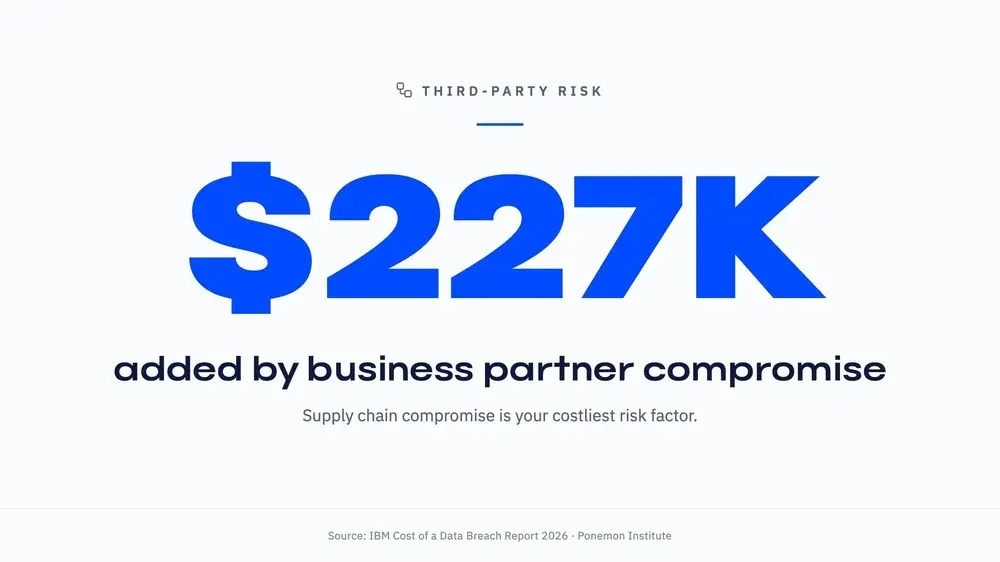
Business partner compromise adds $227,250 to the average cost of a data breach, according to the IBM Cost of a Data Breach Report 2026. IBM identified it as the largest cost-amplifying factor it measured, ahead of security-system complexity and noncompliance with regulations. If that figure doesn't show up in your supplier prioritisation model, your scoring is answering the wrong question.
The gap sits in the question those inputs are built to answer. Most vendor-tiering models ask how likely an incident is; almost none ask how much an incident through this supplier would actually cost.
Expert View

Matt Davies Chief Product Officer, SureCloud |
What our experts say about scoring supplier risk by financial exposure
"Every risk register I review scores suppliers by how likely a breach is. Almost none score what a breach through that supplier would actually cost. That's the gap the IBM numbers finally give us a name for." |
Business partner compromise is the biggest cost amplifier IBM measured
Cost amplification, in IBM's framework, measures how much more expensive a breach becomes when a specific factor is present, beyond the average baseline. That's a financial measure, separate from likelihood.
IBM's 2026 analysis ranked business partner compromise as the factor most strongly linked to higher breach costs, adding $227,250 on top of the average, according to the IBM Cost of a Data Breach Report 2026. Security-system complexity ranked second, adding $208,265. Third was a lack of visibility into the number and location of applications, the report's term for shadow IT, adding $201,165. Regulatory noncompliance followed closely behind at $201,112.
That ordering is worth sitting with. Business partner compromise and shadow IT, ranked first and third, share the same root problem: activity inside the environment that stays outside security's view. Complexity and regulatory noncompliance are factors most organisations already treat as board-level concerns. Business partner compromise, linked to third-party supplier relationships, sits above all three in IBM's cost-amplification ranking.
For a CISO (chief information security officer) building the financial case for third-party risk investment, or a Third-Party Risk Manager deciding which suppliers warrant deeper scrutiny, that's a significant data point. IBM's methodology treats this as an association rather than proven causation: breaches with a business partner as the entry point cost substantially more, on average, than breaches without one.
That's the test worth applying to your current supplier scoring: does it make that association visible?
Supply chain breach cost is higher, and resolution takes longer
The cost-amplification figure sits alongside a separate but related finding. Breaches attributed to supply chain compromise cost an average of $4.96 million to resolve, above the overall $4.99 million breach average IBM recorded across all attack vectors, and took 258 days to identify and contain.
Where supply chain compromise ranks as an attack vector
Supply chain compromise ranked second among initial attack vectors in IBM's 2026 data, behind phishing. Valid-account abuse, drive-by compromise and social engineering followed, tied immediately behind it. It's one of the most common routes into an organisation, and one of the most expensive when it succeeds.
The 258-day lifecycle raises the operational burden of a supply-chain breach. The $227,250 figure shows the additional financial exposure tied to a partner-led entry point. Together, those findings are a strong reason to make supplier-led exposure visible in prioritisation decisions.
A breach originating through a supplier relationship costs more and takes longer to resolve. The next section tests whether current supplier scoring reflects that weight before the incident happens.
Why risk scores can underweight the financial impact
Many vendor-tiering models focus on likelihood, data sensitivity, access and business criticality. Those are useful inputs. The question worth testing is whether the model also surfaces the additional financial exposure if a business partner becomes the route into the organisation.
Most supplier assessments capture some combination of the following:
- Data sensitivity: what categories of data the supplier handles, and in what volume.
- Privileged access: whether the supplier has heightened or persistent access to internal systems.
- Integration criticality: how deeply the supplier's systems connect into core operations.
- Likelihood: the probability of a security incident based on the supplier's own controls maturity.
- Concentration risk: the degree to which the organisation depends on a single supplier or cluster.
- Recoverability: how quickly the organisation could operate if the supplier became unavailable.
These are the right dimensions to measure. The gap sits in the question those inputs are designed to answer. A scoring model built around likelihood and criticality surfaces suppliers most likely to cause a disruption. That's a different question from which suppliers would most amplify the financial cost of a breach if they became the entry point.
The scenario that illustrates the gap
Consider a supplier that scores as moderate-risk on likelihood, with adequate controls and no tier-one critical dependencies. It still holds sensitive customer data, has privileged access to several internal systems, and connects into two or three critical business processes.
On a likelihood-weighted model, it sits in the middle of the risk register. On a cost-amplification lens, it matches the profile IBM's data associates with higher breach costs.
That's the diagnostic question worth adding to existing scoring: how much additional financial exposure this supplier would create if it became the entry point.
Building and maintaining a third-party resilience programme that addresses monitoring, tiering and operational recovery is a separate discipline. This article focuses on a narrower, prior question: whether cost amplification is visible at the point of supplier prioritisation.
Why this should be reviewed now
IBM also found that malicious or criminal attacks accounted for 55% of breaches in 2026, up almost 8% on last year, according to the IBM Cost of a Data Breach Report 2026. The threat environment keeps getting less forgiving.
That broader direction makes it timely to test whether supplier-prioritisation models reflect the financial consequences of a partner-led breach. Supplier relationships assessed two or three years ago may have changed materially since: access levels may have expanded, integrations may have deepened, data volumes may have grown.
The reassessment prompt tests whether the financial dimension of existing supplier relationships is adequately weighted in the decisions already being made.
Organisations that revisit their scoring assumptions now, before a high-cost incident, are in a stronger position to justify prioritisation decisions to the board and to regulators. The UK's National Cyber Security Centre makes the same case from a resilience angle: establishing effective control and oversight of the supply chain is a standing, ongoing discipline. The $227,250 figure gives that board conversation a specific, externally validated anchor.
Score for cost amplification alongside likelihood
The practical recommendation is to add cost amplification as a transparent consideration alongside existing scoring inputs such as likelihood, access, data sensitivity, criticality and recoverability, so the financial exposure of a partner-led breach becomes visible in the prioritisation decision.
Four actions to make cost amplification visible
- Identify your highest-exposure suppliers: start with suppliers that combine sensitive data handling, privileged or persistent access, and deep system integration. These are the relationships where a business-partner compromise would most closely match the profile IBM's data associates with higher costs.
- Document the rationale: for each high-exposure supplier, record why that assessment was reached. An undocumented rationale can't be challenged, reviewed or handed over when team members change.
- Adjust review cadence or tier where appropriate: high-exposure suppliers may warrant more frequent assessments or a higher scrutiny tier, even where their likelihood score is moderate. Review depth should reflect the potential financial consequence, alongside the probability of an incident.
- Assign accountable owners: each high-exposure relationship needs a named owner responsible for the assessment, the remediation plan and the escalation path.
From cost amplification to a working supplier-tiering model
SureCloud's third-party risk management capability is built to help teams surface the suppliers introducing the greatest exposure and turn risk decisions into governed, auditable action. Gracie AI Agents with Personas and Skills identifies high-exposure relationships across the supplier portfolio, so prioritisation decisions reflect actual exposure evidence rather than assessment volume alone.
Teams using SureCloud complete third-party risk assessments 50% faster and onboard new suppliers 40% faster. Gartner recognised SureCloud in its Market Guide for Third-Party Risk Management Technology Solutions in 2025, among 78 Representative Vendors.
A stronger financial weighting is only the first step. The next is translating it into a practical supplier-tiering model that changes review depth, escalation routes and ownership.
SureCloud's guide to third-party cybersecurity risk covers the tiered monitoring cadence and response SLAs behind that kind of programme.
Found this useful?
Choose SureCloud as a preferred source in Google and you will see more of our GRC guidance in Top Stories, AI Overviews and AI Mode. It takes one click and you can undo it at any time.
Let Gracie get the work done.
Gracie drafts summaries, evidence requests and audit narratives across your programme — you stay in control.
See Gracie in action or book a full platform demo →See what SureCloud costs
A short form, no sales call. Pricing built around your GRC estate.
Get PricingIDC names SureCloud the industry's first cross-domain agentic GRC platform
Read the independent analyst view on how SureCloud is redefining risk and compliance.
Download for free