Compliance Management
 Risk Management
 Third Party Risk Management
 Data Privacy Management
 Internal Auditing
 Business Continuity Management
 Continuous Control Monitoring (CCM)
 Trust Center
 AI Governance
- Data Privacy
- AI Governance
- 30th Aug 2026
- 1 min read
How to Justify Your AI Security Budget

- Written by
In Short..
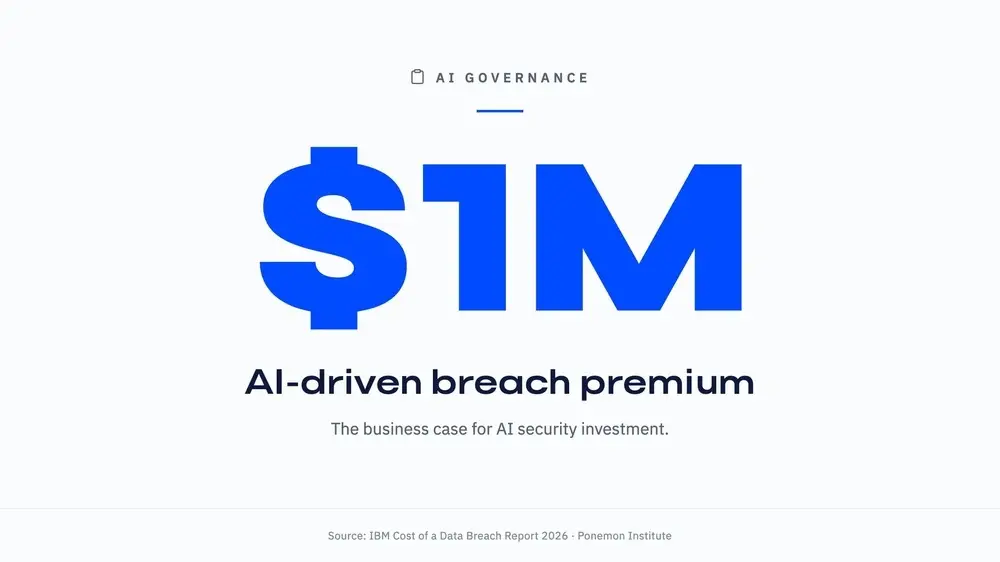
- AI-driven breaches cost $1 million more on average. IBM's 2026 data puts AI-driven breaches at $6.04 million against $5.03 million for breaches without AI involvement, across 602 breached organisations studied.
- The threat has grown 56% in a year. One in four malicious attacks is now AI-driven, and deepfake or impersonation attacks are the largest single category at 45%.
- Access control gaps drive most AI-related breaches. 92% of organisations that suffered an AI-related breach lacked proper AI access controls when it happened.
- Governed AI cuts costs and response time. Organisations using AI and automation extensively in security saved $1.93 million per breach and resolved incidents 65 days faster than those using none of these tools.
AI-driven data breaches now cost organisations an average of $6.04 million, a full $1 million more than breaches with no AI involvement, according to the IBM Cost of a Data Breach Report 2026, conducted by Ponemon Institute. That premium is the number a CISO needs when a CFO asks why security spend should rise when nothing has gone wrong yet. It turns a threat briefing into a financial argument: a quantified exposure set against a known mitigation cost.
Expert View

Matt Davies Chief Product Officer, SureCloud |
What our experts say about governing AI in the security budget
"Every AI security budget conversation lands on the same gap: teams buy detection tools, then find months later nobody logged what the AI did with a customer record. Auditability closes that gap. The spend that pays for itself first makes every AI action logged, permissioned and explainable." |
The CFO Objection: "Why Spend More If Nothing’s Gone Wrong?"
The instinct to demand evidence before approving new spend is a reasonable one for a CFO to hold. The flaw sits in what counts as evidence. Waiting for an AI-driven incident to prove the risk is real means the proof arrives at the same moment as the cost, and by then the money's already gone.
The IBM Cost of a Data Breach Report 2026, conducted by Ponemon Institute across 602 breached organisations worldwide, gives security leaders a way to make the case before that happens: AI-driven attacks now cost $1 million more per breach than attacks without AI, and that gap won't close on its own.
This is a capital allocation question. A board that would readily approve investment against a quantified financial risk anywhere else in the business should apply the same logic here.
The Evidence: AI-Driven Breaches Carry a Measurable Premium
Malicious, AI-driven attacks increased 56% year on year and now account for one in four malicious attacks in the study. That growth isn't even: attack type and sector both shape how much worse an AI-driven breach gets.
Deepfake and impersonation attacks made up 45% of AI-driven activity, the largest single category, followed by AI-enabled malware at 19% and AI-generated phishing at 17%.
Financial services and energy organisations absorbed the concentration: together, the two sectors accounted for 62% of all AI-driven breaches studied, with financial services averaging $6.29 million per incident, $250,000 above the AI-driven breach average.
|
Breach Type |
Average Cost (IBM 2026) |
Share of Malicious Attacks |
|
AI-driven breach |
$6.04 million |
25% |
|
Non-AI-driven breach |
$5.03 million |
75% |
Governance Gaps Are the Real Vulnerability
AI-related security incidents, breaches involving an organisation's own AI models or applications, grew to 21% of breaches this year from 13% last year, a 61% increase. Among the organisations that experienced one, 92% lacked proper AI access controls when the breach happened. That's despite most organisations already treating identity and access management as one of the most effective breach-cost reducers available.
And the pattern repeats with shadow AI, the AI tools employees adopt without approval. Security incidents involving shadow AI more than doubled to 43% this year, up from 20%, and cost an average of $5.39 million, up from $4.63 million last year.
68% of organisations still lack the policies to manage AI or detect shadow AI use, and only 19% coordinate governance and security functions at all.
IBM's data points to a clear pattern: organisations getting hurt by AI are losing to gaps in identity, permissions and oversight that existed before AI ever entered the picture. AI gives attackers a faster way to find those gaps.
The National Cyber Security Centre reaches the same conclusion from a different angle: AI security depends on governance and leadership commitment built in from the start, with responsibility resting on the organisation rather than individual users.
The Financial Case for Governed AI
Security teams using AI and automation extensively, meaning sustained use across prevention, detection, investigation and response, cut their average breach cost to $4.00 million against $5.93 million for organisations using none of these tools. That's a $1.93 million saving.
Identification and containment moved faster too: 215 days for extensive adopters against 280 days for organisations with no use of these tools at all, a 65-day improvement.
The saving compounds when governance is already in place. A record of what an AI system accessed, what it recommended and who reviewed the output turns incident response into a lookup. Governance belongs in the same budget line as detection and response tooling.
Why Now: The Market Has Already Started Moving
The urgency shows up in the numbers. Before organisations in IBM's study learned about the threat capabilities of frontier AI models, 64% said they'd increase security spending following a breach. Once informed of those capabilities, that figure rose to 85%, a 21-point jump that came from awareness alone, with no new incident behind it.
Organisations that understand the exposure are already moving budget toward it. The remaining question is where that budget goes. That shift is why AI governance now sits on board agendas alongside financial and operational risk.
Regulation is moving in parallel. The EU AI Act, the European Union's risk-based framework for regulating artificial intelligence, has been binding on general-purpose AI model providers since August 2025, with transparency obligations now applying from August 2026. High-risk AI system obligations follow in December 2027, after the EU delayed that original deadline this July.
It's EU legislation, so UK organisations enter scope indirectly, through EU customers, data flows or supply-chain relationships. ISO/IEC 42001:2023, the international standard for AI management systems, gives organisations a structured way to demonstrate AI governance to a board, a customer or a regulator in any jurisdiction.
Building a Defensible AI Security Programme
A defensible AI security budget answers three questions for a board or regulator: what did an AI system access, what did it recommend, and who signed off before anything changed. Detection tools answer the first question at best. Governance is what turns AI activity into a record that answers all three. That's the job SureCloud's AI governance capabilities are built to do.
SureCloud calls this discipline Secure, Proven and Repeatable: AI You Can Trust. Gracie AI Agents with Personas and Skills, a virtual GRC team rather than a chatbot bolted onto the platform, is built on it inside SureCloud's GRC (governance, risk, and compliance) platform. Personas define what each agent is authorised to see and do, inheriting the same permissions model as the human role it supports.
Every action runs through an immutable log, so a decision can be reconstructed and explained months later. Material changes still require a person to confirm them before they take effect.
Verdantix, an independent analyst firm, put it directly: "SureCloud's event-based architecture converts every user action into a discrete, traceable event. As regulatory scrutiny intensifies, this architecture will be particularly valuable for firms handling sensitive data in highly regulated sectors.
That structure matters because it puts AI governance inside the same system of record an organisation already uses for risk, compliance and audit. Organisations that want to see how that plays out in reducing cyber risk can start there.
AI governance belongs in the same investment as detection and response. Then, when a board or regulator asks what an AI system did, there's an answer on record.
Found this useful?
Choose SureCloud as a preferred source in Google and you will see more of our GRC guidance in Top Stories, AI Overviews and AI Mode. It takes one click and you can undo it at any time.
Let Gracie get the work done.
Gracie drafts summaries, evidence requests and audit narratives across your programme — you stay in control.
See Gracie in action or book a full platform demo →See what SureCloud costs
A short form, no sales call. Pricing built around your GRC estate.
Get PricingIDC names SureCloud the industry's first cross-domain agentic GRC platform
Read the independent analyst view on how SureCloud is redefining risk and compliance.
Download for free