Compliance Management
 Risk Management
 Third Party Risk Management
 Data Privacy Management
 Internal Auditing
 Business Continuity Management
 Continuous Control Monitoring (CCM)
 Trust Center
 AI Governance
- ISO 42001
- AI Governance
- 28th May 2026
- 1 min read
EU AI Act vs ISO 42001: What Compliance Leaders Actually Need to Know

- Written by
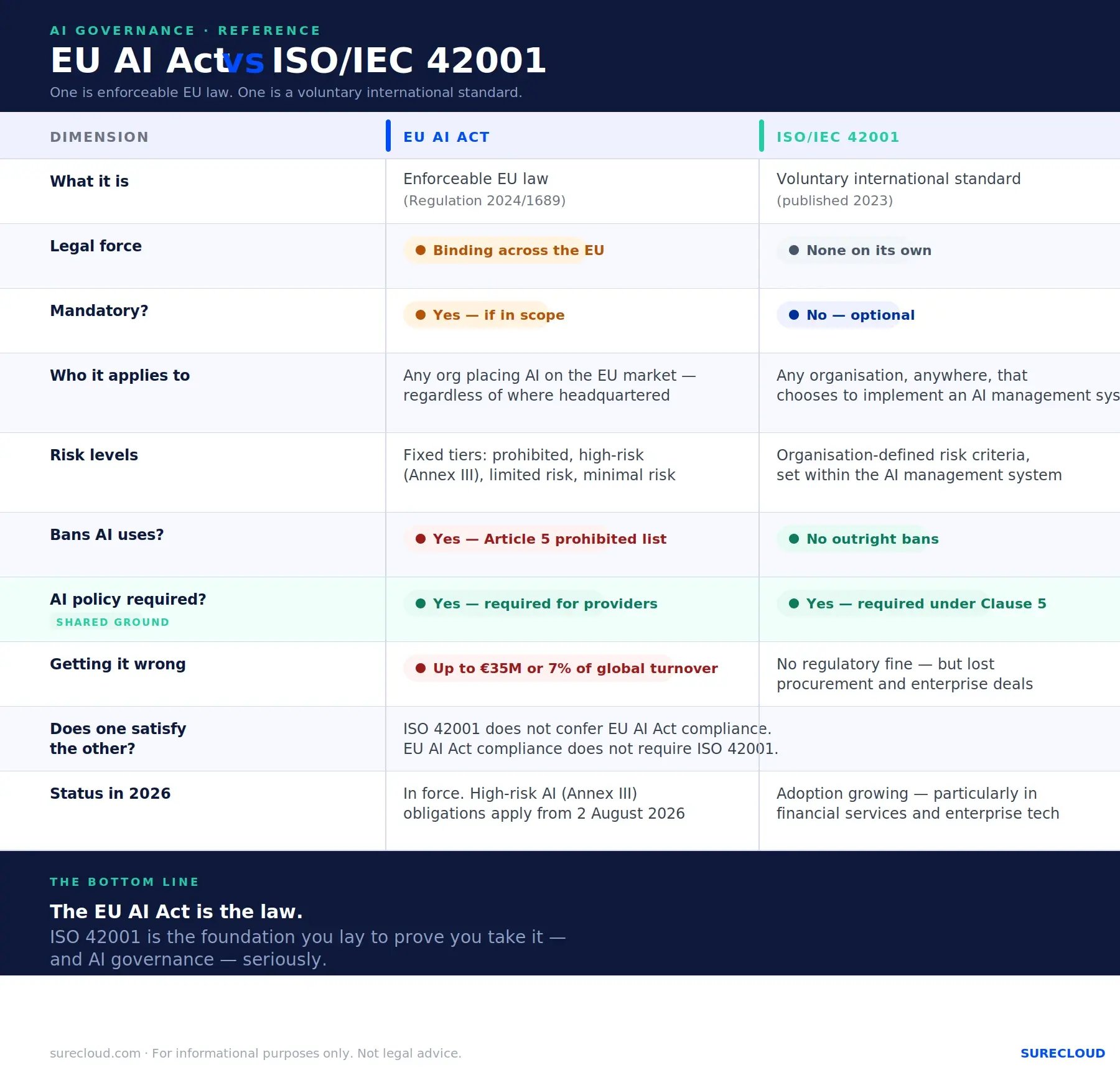
EU AI Act vs ISO/IEC 42001
Comparison Table
Does the EU AI Act or ISO 42001 apply to you?
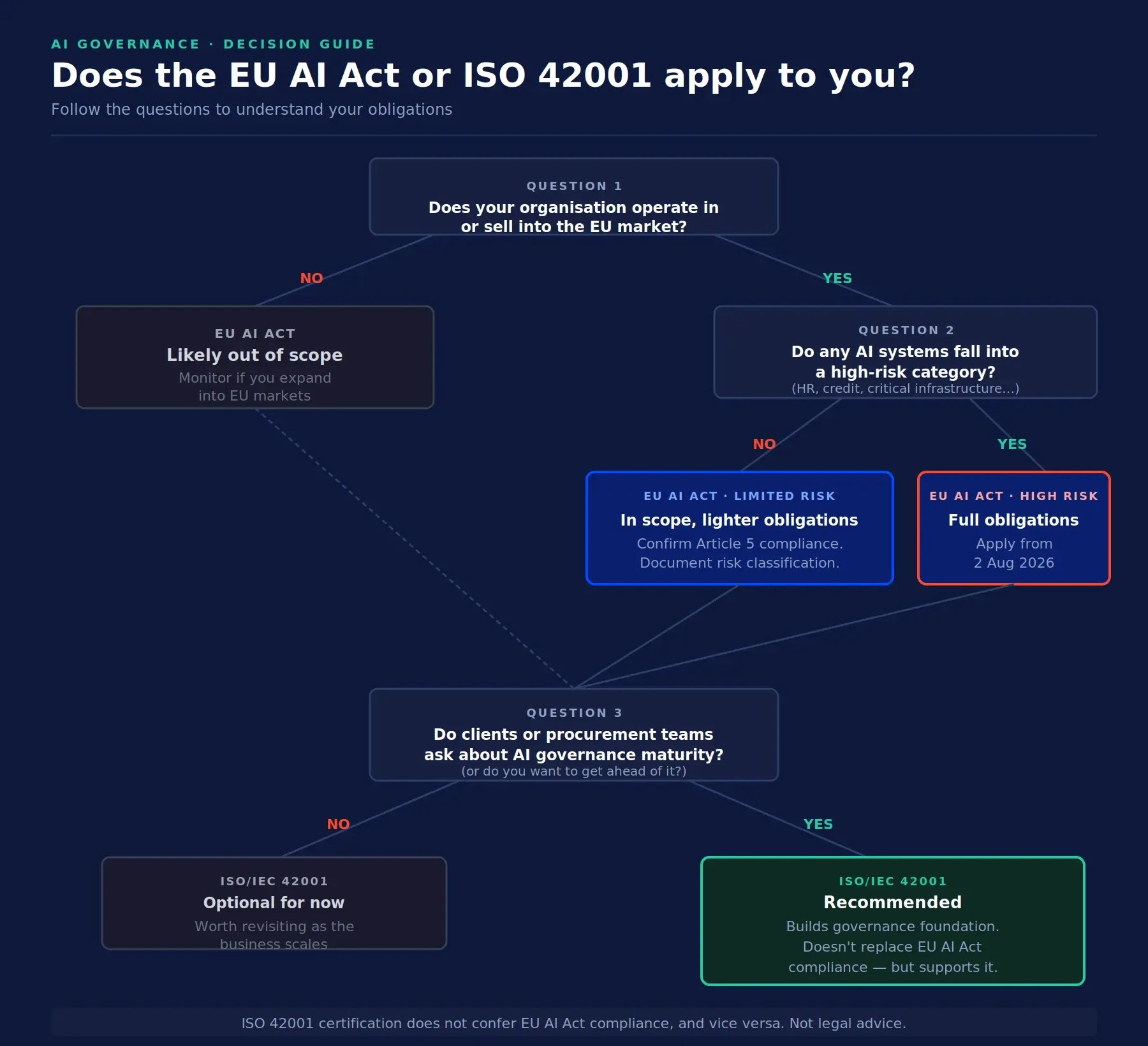
The EU AI Act, the European Union’s binding regulation on artificial intelligence that entered into force on 1 August 2024, and ISO 42001:2023, the international standard for AI management systems published by the International Organization for Standardization, are frequently conflated — often with material consequences for risk and compliance functions. One is law with regulatory enforcement and substantial financial penalties; the other is a voluntary framework against which organisations can seek third-party certification. Certification to ISO 42001 does not make an organisation legally compliant with the EU AI Act, and compliance with the EU AI Act does not require ISO 42001 certification. Understanding what each requires, who enforces each, and how they interact is increasingly non-negotiable for any organisation deploying or procuring AI systems in or for the EU market.
Go Deeper on ISO:42001 and AI Governance: Explore the full ISO:42001 Resource Hub here
Why the Distinction Matters Now
The EU AI Act applies to any organisation that develops, deploys, imports, or distributes AI systems within the European Union — regardless of where that organisation is headquartered. A UK-based financial services firm with EU customers, or a US software company whose product is used by EU organisations, is within scope. The Act is not a future concern: the prohibition on unacceptable risk AI systems under Article 5 applied from 2 February 2025, and obligations for general purpose AI (GPAI) model providers applied from 2 August 2025. The timeline for high-risk AI systems has recently shifted — see the AI Omnibus section below.
ISO 42001:2023 is a management system standard — the same structural category as ISO 27001 for information security or ISO 9001 for quality management. It provides a structured approach to establishing, implementing, maintaining, and continually improving an AI management system (AIMS). Certification is awarded by accredited certification bodies following a third-party audit. No regulator requires ISO 42001 certification as a legal obligation. What regulators require — under the EU AI Act specifically — is conformity with the Act’s technical and governance requirements, which are specified in the legislation itself and elaborated through implementing guidance published by the European Commission.
The commercial pressure to pursue ISO 42001 certification is real and growing. Enterprise procurement processes are increasingly including AI governance certification as a supplier qualification criterion, and the standard has attracted early adopters across financial services, technology, and professional services. Organisations certified to ISO 27001 can build on significant structural overlap, given both standards use the Annex SL high-level framework. That commercial signal is legitimate. The risk arises when certification is treated as a legal compliance proxy rather than a governance maturity indicator — a distinction that regulators, and increasingly enterprise legal teams, are beginning to test.
What the EU AI Act Actually Requires
The EU AI Act, Regulation (EU) 2024/1689, establishes a risk-based framework for AI systems. Its central mechanism is a four-tier classification of AI risk, with mandatory obligations that escalate with risk level.
Unacceptable Risk (Article 5)
AI systems that pose unacceptable risks are prohibited outright under Article 5. These include systems that deploy subliminal manipulation techniques to distort behaviour, exploit vulnerabilities of specific groups, carry out social scoring by public authorities, and — with narrow law enforcement exceptions — real-time remote biometric identification in public spaces. The AI Omnibus, agreed in May 2026, extended the prohibited list to include AI systems that generate or manipulate non-consensual intimate imagery of identifiable individuals. These prohibitions are in force and apply now. No management system certification remediates a breach of Article 5; systems within scope must be discontinued.
High-Risk AI Systems (Articles 6 and 9–49)
High-risk AI systems, defined under Article 6 and Annex III, face the most extensive obligations. Annex III categories include AI used in biometric identification, critical infrastructure, education, employment and worker management, access to essential services, law enforcement, migration and border control, and administration of justice. For providers of high-risk systems, obligations include:
- Establishing a quality management system under Article 17
- Conducting a conformity assessment under Articles 43–44 before placing the system on the market
- Registering the system in the EU database under Article 49
- Maintaining technical documentation under Article 11 and Annex IV
- Implementing a risk management system under Article 9, operated on a continuous basis throughout the system lifecycle
- Ensuring data governance under Article 10, covering training, validation and testing datasets
- Enabling human oversight under Article 14
- Maintaining transparency and providing instructions for use under Articles 13 and 47
- Obligations for standalone high-risk AI systems under Article 6(2) and Annex III — originally due to apply on 2 August 2026 — are deferred to 2 December 2027
- Obligations for high-risk AI systems embedded in regulated products under Annex I — originally 2 August 2027 — are deferred to 2 August 2028
Deployers — organisations that use high-risk AI systems rather than develop them — have their own obligations under Article 26, including conducting fundamental rights impact assessments in certain contexts, monitoring system operation, and ensuring human oversight is implemented in practice. Deployers cannot transfer regulatory liability to providers by contract where the Act places obligations directly on the deployer.
Limited and Minimal Risk
AI systems at limited risk, principally chatbots and systems generating synthetic content, face transparency obligations under Articles 50–52, requiring users to be informed when they are interacting with an AI system or consuming AI-generated content. Under the AI Omnibus agreement, providers of generative AI systems released before 2 August 2026 have until 2 December 2026 to apply watermarking or other machine-readable transparency solutions. Minimal risk systems face no mandatory requirements, though voluntary codes of conduct are available.
General Purpose AI Models (Articles 51–56)
The EU AI Act introduces obligations for providers of general purpose AI (GPAI) models — foundation models capable of serving a wide range of downstream tasks. Under Article 53, GPAI model providers must maintain technical documentation, comply with EU copyright law, and publish a summary of training data. Providers of GPAI models with systemic risk — defined under Article 51 primarily by reference to training compute thresholds — face additional obligations including model evaluation, adversarial testing and incident reporting to the European AI Office. These obligations applied from 2 August 2025. In July 2025, the European Commission published guidelines clarifying the scope of GPAI obligations and a voluntary General Purpose AI Code of Practice, providing implementation-level guidance for providers.
Enforcement and Penalties
The EU AI Act is enforced by national competent authorities in each member state, with the European AI Office — established within the European Commission — overseeing GPAI model obligations. Penalties under Article 99 are tiered: violations of the Article 5 prohibitions carry fines up to €35 million or 7% of global annual turnover, whichever is higher. Violations of other obligations for high-risk systems carry fines up to €15 million or 3% of global turnover. Providing incorrect or misleading information to a notified body or national authority carries fines up to €7.5 million or 1% of global turnover. For SMEs, the lower of the two thresholds applies.
The AI Omnibus: Revised Timelines
On 7 May 2026, the European Parliament and the Council of the EU reached a provisional agreement on the Digital Omnibus on AI, a package of targeted amendments to the EU AI Act proposed by the European Commission in November 2025. The most significant change is a deferral of the high-risk AI compliance deadlines. Under the provisional agreement, which is pending formal ratification:
The deferral is intended to allow technical standards and Commission guidance tools to catch up with implementation timelines. It does not change the obligations themselves, and it does not affect the prohibitions under Article 5, the GPAI obligations under Chapter V, or the transparency requirements under Articles 50–52. Organisations should continue building toward compliance against the revised deadlines and not treat the extension as a reason to pause preparation. The Omnibus has not yet been formally adopted; until it is, the original 2 August 2026 deadline for Annex III high-risk systems remains law.
What ISO 42001:2023 Actually Provides
ISO/IEC 42001:2023 specifies requirements for establishing, implementing, maintaining and continually improving an artificial intelligence management system (AIMS) within an organisation. Published in December 2023, it is the first international standard specifically addressing AI management systems. Its structure follows the Annex SL high-level framework used by ISO 27001, ISO 9001 and other management system standards, allowing it to integrate readily with existing governance programmes.
Core Requirements
The standard requires organisations to define the context of AI use, identify internal and external stakeholders, establish AI-related policies, assign roles and responsibilities, conduct risk and impact assessments for AI systems, and implement operational controls. Clause 5 addresses leadership and policy. Clause 6 covers planning, including the AI risk assessment and impact assessment process. Clause 8 addresses operational planning and control, including requirements around the AI system development lifecycle. Clause 9 covers performance evaluation — monitoring, measurement, internal audit and management review. Clause 10 addresses continual improvement. Annex A provides a reference set of controls, including provisions for data quality, system transparency, human oversight and incident management.
What Certification Demonstrates
An ISO 42001 certificate demonstrates that an organisation has implemented an AI management system that has been independently audited against the standard’s requirements. It demonstrates process maturity, governance structures, and a systematic approach to AI risk management across an AI portfolio. It does not demonstrate conformity with the EU AI Act, which has its own specific technical and documentation requirements set out in statute. It does not constitute a conformity assessment under the Act’s Chapter V procedures.
ISO 42001 certification is not irrelevant to EU AI Act compliance. An organisation with a well-implemented AIMS is likely to have established many of the governance foundations — documented policies, risk assessment processes, defined roles and responsibilities for AI systems, incident management — that also underpin EU AI Act compliance. The Clause 6.1 risk assessment process in ISO 42001 maps loosely to the Article 9 risk management system required for high-risk AI, and the Annex A controls on data quality and transparency provide a useful starting point for the Article 10 and Article 13 obligations. But the overlap is partial, and the Act’s requirements are more prescriptive where they apply. ISO 42001 is a useful organising framework; it is a starting point, not a destination.
Side-by-Side Comparison: EU AI Act vs ISO 42001
|
Dimension |
EU AI Act |
ISO/IEC 42001:2023 |
|
Legal status |
Binding EU law (Regulation) |
Voluntary international standard |
|
Who enforces it |
National competent authorities; European AI Office (GPAI obligations) |
No regulator — accredited certification bodies audit against it |
|
Applies to |
Providers, deployers, importers and distributors of AI systems used in the EU |
Any organisation that chooses to implement an AIMS and seek certification |
|
Consequence of non-compliance |
Fines up to €35M or 7% of global turnover; product market withdrawal |
No regulatory consequence; potential commercial disadvantage in procurement |
|
How compliance is demonstrated |
Conformity assessment + technical documentation for high-risk systems; no third-party certification |
Third-party certification by accredited certification bodies (3-year cycle) |
|
Risk classification |
Four statutory tiers: unacceptable, high-risk, limited risk, minimal risk |
Organisation-defined risk assessment process under Clause 6.1 |
|
Technical documentation |
Mandated under Article 11 and Annex IV for high-risk systems |
Required as part of AIMS documentation but to organisation-defined scope |
|
Human oversight |
Mandatory for high-risk AI under Article 14 |
Addressed in Annex A controls; no prescriptive requirement |
|
Does one satisfy the other? |
EU AI Act compliance does not require ISO 42001 certification |
ISO 42001 certification does not confer EU AI Act compliance |
Where ISO 42001 Helps — and Where It Does Not
Where It Helps
For organisations whose AI systems fall within the EU AI Act’s scope, an ISO 42001-aligned management system provides governance infrastructure that supports — though does not substitute for — legal compliance. The areas of genuine overlap include:
- The policy and objective-setting requirements under ISO 42001 Clauses 5 and 6 align with the EU AI Act’s expectation that providers maintain documented AI governance structures, including quality management system requirements under Article 17
- The risk assessment process under ISO 42001 Clause 6.1 maps loosely to the risk management system required under Article 9 of the EU AI Act, though the Act’s requirements are more prescriptive and must be operated continuously throughout the system lifecycle
- The incident management and corrective action requirements in ISO 42001 Clauses 10.1 and 10.2 support the post-market monitoring obligations under Article 72 of the EU AI Act
- ISO 42001 Annex A controls on data quality, transparency and human oversight provide a useful implementation starting point for the data governance obligations under Article 10 and the transparency requirements under Article 13
- For organisations already certified to ISO 27001, the shared Annex SL structure of ISO 42001 means that governance infrastructure — management review processes, internal audit programmes, corrective action frameworks — can be extended to AI rather than rebuilt from scratch
Where It Does Not Help
ISO 42001 does not address the EU AI Act’s conformity assessment procedures for high-risk AI systems under Articles 43–44. It does not substitute for the specific technical documentation required under Article 11 and Annex IV. It does not confer the EU database registration required under Article 49. It does not address GPAI model obligations under Articles 51–56, including the training data summary and copyright compliance requirements under Article 53. And it does not engage with the prohibited practices under Article 5 — those are statutory prohibitions, not governance gaps that a management system can close.
Practical Implications for Compliance Leaders
The question for a risk or compliance function is not which framework to choose. Both may be relevant. The question is how to sequence them, and how to prevent one from substituting for the other.
- Determine EU AI Act scope first. Identify all AI systems your organisation develops, deploys or procures, classify them by the Act’s risk tiers, and map the specific legal obligations that apply. This is a legal analysis that should involve your legal function or external counsel. It is not a certification exercise.
- Use ISO 42001 as a governance organising framework across your AI portfolio. The standard is well-suited to managing AI risk across systems that fall below the EU AI Act’s high-risk threshold, and to embedding systematic governance processes for the systems that are in scope. The AIMS also provides a governance layer that internal audit and external stakeholders can assess independently.
- Treat ISO 42001 certification as a commercial signal, not a legal one. Enterprise customers and procurement functions increasingly require evidence of AI governance maturity. Certification provides that evidence credibly. Do not represent it to customers, regulators, or notified bodies as EU AI Act compliance.
- Build the gap analysis explicitly. For systems in scope under the EU AI Act, map your existing ISO 42001 controls against the Act’s specific requirements and document what is missing. The gaps will be real — particularly around conformity assessment procedures, the technical documentation requirements of Annex IV, and the data governance obligations of Article 10.
- Account for the AI Omnibus timeline shift. The provisional agreement reached in May 2026 extends the Annex III high-risk compliance deadline to December 2027. That extension creates headroom — it does not create a reason to slow down. Use the additional time to build compliance programmes that are substantive rather than reactive.
- Factor in the UK context separately. The UK has not adopted the EU AI Act and has taken a principles-based, sector-led approach to AI regulation. UK-only deployments are not subject to the Act’s requirements, though UK organisations with EU market exposure are. The ICO, FCA and sector regulators each have AI-related expectations that require separate mapping.
Found this useful?
Choose SureCloud as a preferred source in Google and you will see more of our GRC guidance in Top Stories, AI Overviews and AI Mode. It takes one click and you can undo it at any time.
Let Gracie get the work done.
Gracie drafts summaries, evidence requests and audit narratives across your programme — you stay in control.
See Gracie in action or book a full platform demo →See what SureCloud costs
A short form, no sales call. Pricing built around your GRC estate.
Get PricingIDC names SureCloud the industry's first cross-domain agentic GRC platform
Read the independent analyst view on how SureCloud is redefining risk and compliance.
Download for free