Compliance Management
 Risk Management
 Third Party Risk Management
 Data Privacy Management
 Internal Auditing
 Business Continuity Management
 Continuous Control Monitoring (CCM)
 Trust Center
 AI Governance
- Agentic AI
- 15th Jun 2026
- 1 min read
5 Agentic AI Compliance Tasks That Work in 2026

- Written by
Summary
Agentic AI can reliably automate evidence collection, continuous controls monitoring, third-party questionnaire processing, regulatory change monitoring, and policy attestation tracking. It should not be used for regulatory interpretation, risk acceptance decisions, material stakeholder communications, contextually complex exceptions, or final compliance sign-off. In mature deployments, agents handle 20 to 40 percent of repetitive compliance work; the remaining 60 to 80 percent still requires human judgement. The boundary between the two is not a technology question. It is a governance one.
Working out where AI fits in your GRC programme? Our agentic AI in GRC resource hub brings together everything in one place: what agentic AI can and can't do, responsible AI governance, build vs buy, platform evaluation, and accountability for AI-driven decisions. Start there to deploy AI in GRC safely.
Introduction
Compliance professionals spend 30 to 50 percent of their working week on manual tasks: pulling screenshots, chasing evidence, populating spreadsheets, and re-checking controls that were checked last quarter. That is not a skills problem. It is an execution problem.
Agentic AI is changing the calculus. Not by replacing compliance judgement, but by absorbing the volume of work that never required it in the first place. The question is not whether to use AI agents in your programme. It is knowing precisely where they belong and where they do not.
The honest answer: agents are currently handling 20 to 40 percent of repetitive compliance work in mature deployments. The remaining 60 to 80 percent still needs a human. The practitioners who understand that boundary will get real value from these tools. Those who believe the vendor pitch about "lights-out automation" will end up with audit findings they cannot explain.
Here is a practical split: five tasks where agentic AI earns its place, and five where it will get you into trouble.
Five compliance tasks agentic AI can automate now
1. Evidence collection for audits
This is the clearest win. Evidence gathering for ISO 27001, SOC 2, or PCI DSS involves pulling access logs, configuration snapshots, policy version histories, and user access reviews from multiple systems, then mapping each piece to a specific control. It is high-volume, rule-bound, and deeply tedious.
An agent with the right integrations can perform this continuously: querying your IAM, SIEM, HRIS, and cloud infrastructure on a defined schedule, deduplicating results, and packaging evidence against control requirements.
With SureCloud, that continuous approach cuts manual evidence collection effort by 50 to 65% and reduces audit preparation time by 75%.
What the agent does: pulls, maps, and packages. What you still do: verify the evidence is complete and defensible before it goes to an auditor.
2. Continuous controls monitoring
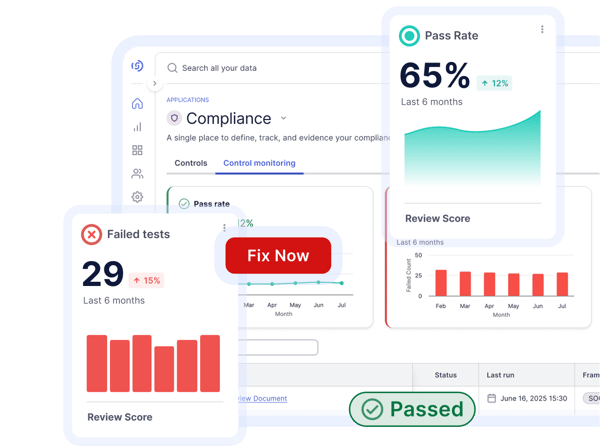
Point-in-time testing is a structural weakness. Your controls were healthy in January. What happened in March? An agent running continuous controls monitoring checks whether each control is operating as designed, flags drift the moment it occurs, and routes the exception to the right owner.
The Forrester 2025 Security Benchmark found that organisations with continuous visibility reduced audit findings by 41 percent compared to those relying on periodic assessments. That gap is almost entirely explained by the time between a control failing and someone noticing.
This is exactly what SureCloud's continuous controls monitoring capability is built for: always-on assurance, not annual snapshots.
3. Third-party questionnaire processing and scoring
Your vendor risk team sends questionnaires. Vendors return them, often inconsistently formatted, with answers that need cross-referencing against your risk criteria. A human analyst reads each one, scores it, flags gaps, and decides whether to escalate. This takes hours per vendor.
An agent can ingest completed questionnaires, extract responses, score them against your risk framework, flag missing or contradictory answers, and produce a pre-digested risk summary for analyst review. The analyst moves from reading everything to reviewing exceptions. According to FinTech Global's 2026 compliance survey, probability-based scoring algorithms can reduce low-level alerts by up to 82 percent, which translates directly to this use case.
4. Regulatory change monitoring and gap analysis
Regulatory updates arrive constantly: new guidance, revised frameworks, updated technical standards. Someone on your team needs to read them, assess what has changed, and identify whether your controls need updating. That someone is usually already overloaded.
An agent can monitor regulatory sources continuously, summarise changes relevant to your framework coverage, and flag specific controls that may need review. It does not make the compliance decision. It ensures nothing slips through because your team was busy with last quarter's audit.
Read: Agentic AI for regulatory change management to learn how this works in practice.
5. Policy attestation and training completion tracking
Chasing staff to confirm they have read the acceptable use policy, completed mandatory training, or acknowledged a control change is pure administration. It produces no insight. An agent can manage the entire cycle: send, remind, escalate, record, and report. Completion rates, outstanding items by team, and overdue attestations are available in real time rather than assembled manually before a board report.
|
Task |
What the agent handles |
What stays with you |
|---|---|---|
|
Evidence collection |
Pulling, mapping, packaging |
Verification and sign-off |
|
Controls monitoring |
Continuous testing, drift detection |
Exception review and remediation |
|
Vendor questionnaires |
Ingestion, scoring, flagging |
Risk decisions and escalations |
|
Regulatory monitoring |
Change detection, gap flagging |
Compliance interpretation |
|
Policy attestation |
Sending, chasing, recording |
Governance and escalation decisions |
Five compliance tasks agentic AI should not touch
The risk with agentic AI is not that it will fail obviously. It is that it will fail quietly, producing outputs that look correct but contain errors that only surface when an auditor or regulator looks closely. In 20 years of building GRC programmes, the failures that cost organisations most are rarely the visible ones. They are the quiet ones that pass review and surface under scrutiny. These are the tasks where that risk is highest.
1. Regulatory interpretation and compliance opinion
Regulations are not written in machine-readable language. They contain ambiguity, cross-references, and contextual nuance that requires professional judgement to interpret. Whether a particular activity constitutes processing under GDPR, whether a control satisfies a specific DORA requirement, or whether a third-party relationship triggers enhanced due diligence: these are legal and professional judgements.
An agent can surface the relevant regulatory text. It cannot tell you what it means for your specific business context. That call belongs to a qualified professional, and the accountability for it cannot be delegated to a model.
2. Risk acceptance decisions
Risk acceptance is a governance act. Someone with appropriate authority is formally acknowledging that a residual risk sits within appetite, and accepting personal accountability for that decision. An agent can calculate a risk score. It can present the evidence. It cannot accept the risk.
Why this matters: if an agent is approving risk acceptances autonomously, your risk register is not a governance document. It is a log of machine outputs. Regulators and auditors are increasingly aware of this distinction.
3. Stakeholder and auditor communication on material issues
When something has gone wrong, or when a finding requires explanation, the communication needs to come from a human who understands the context, can field follow-up questions, and can commit to remediation. An agent-drafted response to an auditor query about a material control failure is not appropriate. The drafting assistance is fine. The accountability for what is said is not transferable.
4. Exceptions with business context
Some compliance exceptions are straightforward: a control failed, here is why, here is the remediation plan. Others are complex: the control failed because of a deliberate business decision made at a senior level, with trade-offs that require contextual understanding to assess fairly.
An agent operating on rules will not recognise the difference. It will apply the same exception-handling logic to both. The result is either over-escalation of trivial issues or, worse, under-escalation of genuinely significant ones. This is precisely the boundary that defines the 60 to 80 percent of compliance work still requiring human judgement: the moment an exception carries business context, it leaves the agent's remit.
5. Final sign-off on compliance status
Your annual compliance attestation, your SOC 2 management assertion, your DORA ICT risk framework sign-off: these are formal statements made by accountable individuals. An agent cannot sign off on compliance status, because compliance status is not just a data output. It is a professional judgement backed by human accountability.
The principle: if the output requires a name and a signature, a human must own it. Agents produce the evidence. Humans certify it.
The practical implication is that agentic AI works best as a force multiplier for your existing team, not a replacement for it. The SureCloud Agentic AI Resource Hub lets out how organisations are structuring this in practice: agents handling execution, humans handling judgement, with clear escalation paths between them.
How to decide where your agents should operate
Before deploying an agent on any compliance task, apply three tests:
The most common failure we see in early deployments is not a model problem. Organisations go live with agents before they have resolved the data quality issues that were already causing their manual processes to break. The agent then systematises the problem, producing confident-looking outputs built on inconsistent source data. By the time anyone notices, the errors are distributed across multiple controls.
- Is the underlying data clean? Agents propagate errors at scale. If your identity system, firewall logs, or policy repository are inconsistent, the agent will process that inconsistency faithfully and produce confident-looking wrong answers. Fix the data first.
-
Is every agent decision fully auditable? Deloitte's research across 3,000 C-suite leaders found that only 21 percent of companies have adequate oversight mechanisms for autonomous agents. The implication is direct: if you cannot reconstruct exactly what the agent did, why, and when, you cannot defend it to a regulator.
- Does a human retain clear override authority? This is not optional. The EU AI Act requires defined escalation thresholds for AI systems operating in compliance-sensitive workflows. If confidence drops below a defined level, the agent must hand off to a human. That threshold needs to be documented and tested, not assumed.
Organisations that pass these three tests before expanding agent use are the ones building programmes that hold up under scrutiny. Those that skip them are the ones generating the 42 percent audit finding statistic.
Where Gracie AI Agents with Personas and Skills fit
Gracie AI Agents with Personas and Skills are a virtual GRC team: each agent has a defined role, operates within codified expertise, and maintains a complete audit trail of every activity it performs. An Evidence Agent gathers and maps. A Controls Agent monitors and flags. A Vendor Risk Agent processes and scores. Each one is scoped to what it can reliably do, with human review built into the workflow at the points where judgement is required.
This is not lights-out automation. It is agent-led GRC: the work that can be systematised is systematised, so your team's time goes to the decisions that cannot be.
Found this useful?
Choose SureCloud as a preferred source in Google and you will see more of our GRC guidance in Top Stories, AI Overviews and AI Mode. It takes one click and you can undo it at any time.
Let Gracie get the work done.
Gracie drafts summaries, evidence requests and audit narratives across your programme — you stay in control.
See Gracie in action or book a full platform demo →See what SureCloud costs
A short form, no sales call. Pricing built around your GRC estate.
Get PricingIDC names SureCloud the industry's first cross-domain agentic GRC platform
Read the independent analyst view on how SureCloud is redefining risk and compliance.
Download for free