Compliance Management
 Risk Management
 Third Party Risk Management
 Data Privacy Management
 Internal Auditing
 Business Continuity Management
 Continuous Control Monitoring (CCM)
 Trust Center
 AI Governance
-
AI-driven automation is transforming IT governance in 2025, reducing manual load in evidence collection, configuration reviews and control monitoring, while improving speed, accuracy and visibility across hybrid and cloud environments.
-
Human oversight remains essential, with IT teams expected to apply strong governance, reviewer checks and escalation paths to ensure AI-assisted findings, mappings and remediation guidance remain correct, auditable and aligned to internal policies and external standards.
-
Incremental adoption delivers the strongest ROI. IT teams that modernise in phases, using curated control libraries, automated dependency mapping and structured approval workflows, reduce rework, minimise configuration drift and improve operational resilience without introducing unnecessary automation risk.
-
Integrated platforms outperform siloed tooling, giving IT leaders unified visibility across assets, risks and controls, accelerating incident response and supporting more confident, data-backed decision-making.
The Risk Reckoning - Exclusive Industry Research report
Highlights
Who Should Read This?
For Enterprise GRC Leaders If you’re responsible for risk, compliance, or audit across a large, complex organization, this report provides a reality check on operational blind spots and strategic opportunities.
For Mid-Market & SMB Teams If you manage risk and compliance in a smaller organization this report surfaces those unique challenges for lean teams. Discover practical strategies to move beyond spreadsheets, automate the essentials, and achieve real control and resilience, even with limited capacity.
For Advisors, Consultants, and Solution Partners If you advise or support UK organisations on risk and compliance, this analysis offers data-driven insights to sharpen your recommendations. Understand what’s working, what isn’t, and where your customers need the most help- whether they’re navigating enterprise complexity or SMB realities.
Abstract
87% of Enterprise executives claim preparedness for a major GRC event, but their own survey responses expose systemic, ongoing issues: fragmented tools, manual processes, skills shortages, and budget constraints. Among SMB organisations, 95% of leaders report a similar level of confidence, yet that assurance is built on widespread reliance on spreadsheets, limited resources, and a reactive approach to certification.
“Enterprise” refers to organisations surveyed with greater than 1,000 employees, whilst “SMB” covers those organisations with 51 to 1,000 employees. “Scaling or growing teams” are those with fewer than 25 dedicated GRC employees. 63% of SMBs had only between 1-5.
How can both groups project readiness while facing deep operational cracks? This disconnect is the central tension, the “risk reckoning”, facing UK organisations today.
By integrating insights from both segments for the first time, this report highlights the growing pressures on SMBs who are often overlooked in GRC (but are now facing real uncertainty about how to move forward) as well as the persistent operational gaps undermining enterprise confidence.
Together, these findings reveal the disconnect between perception and reality that continues to define governance, risk and compliance (GRC) management in 2025.
For large enterprises, complexity and multiframework compliance drive inefficiency and persistent blind spots. For SMBs, resource scarcity and fragmented manual controls create a different, but equally dangerous landscape. Across all sizes, the real risk is not a breach or audit failure, but the mistaken belief that legacy methods- spreadsheets, manual workarounds, and disconnected tools, offer genuine control.
Even the organisations that feel most prepared continue to face major breaches, underscoring the gap between perceived confidence, actual practice and true resilience. Across this report, SureCloud has uncovered where these perceptions diverge from reality, what is uniquely challenging in each segment, and how leaders can close the gap between confidence and capability.
The New Realities Facing GRC Leaders
“The biggest risk isn’t a breach or fine. It’s thinking everything is under control when it isn’t.”
UK businesses of every size face unprecedented pressure to manage risk, maintain compliance, and adapt to fast-evolving regulatory demands. But the true experience of governance, risk, and compliance (GRC) is anything but uniform.
For large enterprises, the landscape is dominated by complexity: sprawling business structures, layers of oversight, and the constant challenge of integrating multiple frameworks and technologies; a scale of responsibility that often exceeds the capacity of even well-established, but relatively small, GRC teams.
Smaller organisations are also navigating the same regulatory environment, but must do so with even leaner teams, smaller budgets, and limited capacity or knowledge that clouds their vision.
On the surface, confidence in GRC programs remains strikingly high. Enterprise executives, backed by significant investment and formal policies, are quick to cite preparedness and board-level engagement. SMB leaders, meanwhile, take pride in agility, visibility, and the ability to do more with less.
Yet beneath the optimism, both segments acknowledge ongoing struggles: persistent manual workarounds, fragmented tools, skills shortages, and the relentless pressure to “do more with less.” For many, the real challenge isn’t a lack of ambition, it’s the operational reality of sustaining GRC maturity amid resource and complexity constraints.
For the first time, SureCloud’s Risk Reckoning brings together these two perspectives in a unified study. Drawing on survey data from nearly 200 executives and leaders across the market in both large enterprises and small businesses, this report delivers the UK’s only end-to-end GRC maturity snapshot.
By directly comparing the experience of enterprise and SMB organisations, it surfaces not just universal truths and sector-wide challenges, but also the unique pain points and opportunities for progress that define each segment.
The Goal: Closing the persistent gap between GRC confidence and capability, making it easier than ever for teams big or small to improve their security posture.
GRC Team Capacity by Business Size
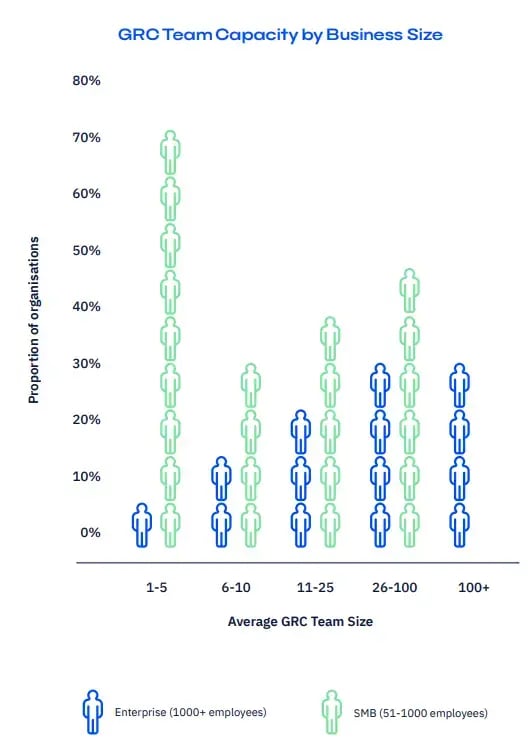
The chart highlights the stark contrast in how UK organisations resource GRC. Enterprises typically operate with much larger, dedicated teams, reflecting the complexity of multi-framework compliance and global oversight. SMBs, however, rely on extremely lean teams of 1–10 people, often balancing GRC with broader IT or security responsibilities.
This capacity gap shapes how each group experiences GRC: enterprises battle complexity despite headcount, while SMBs face bandwidth constraints and heavy reliance on manual processes. Both pressures contribute to the confidence–capability disconnect explored throughout this report.
The Enterprise Perspective
What Executives Say Is Going Well
- GRC Maturity: Nearly 60% rank their GRC programs as ‘Optimizing’ or ‘Measured’ meaning data-driven outcomes, automation and real-time insights.
- Board Engagement: GRC is discussed at board level in 75% of firms with nearly half of this figure addressing it in 2/3rds of meetings.
- Resource Investment: 59% of firms have 25+ full-time GRC staff; 28% have 100+.
Integrated Tooling: Enterprises enrich GRC tools with further point solutions providing threat intelligence (74%), continuous controls monitoring (67%), and automated reporting (66%).
Tangible Business Impact
Leaders cite improvements in decision-making (64%), risk response (55%), and competitive advantage (51%) because of GRC programs
Enterprise leaders across the UK are outwardly optimistic about the state of their GRC programs and when asked directly, they point to several clear indicators of success:
- Significant investments: Most organisations (59%) have dedicated more than 25 full-time employees exclusively to GRC tasks, and over a quarter (28%) employ 100 or more. On top of their chosen GRC platform many enterprises are also buying advanced point solutions around cyber threat intelligence (74%), real-time controls monitoring (67%), and automated reporting (66%).
- Engaged stakeholders: At 75% of companies GRC is regularly discussed at board meetings. Nearly all C-level executives (90%) and most board members (64%) are directly involved in key governance decisions.
- Measurable benefits: Executives note tangible business improvements since actively measuring GRC effectiveness, such as better decision-making (64%), better response capabilities (55%), and competitive advantage (51%). • High maturity and preparedness: Most business leaders consider their programs mature, with nearly 60% rating them “Optimizing” or “Measured,” and a full 87% claiming their organization is prepared to handle a significant GRC event today.
Things look solid from the top when GRC works by most conventional measures. Based on these results alone, executive optimism is relatively easy to justify, and many organisations seem truly prepared. But there’s more here than meets the eye. Most of these metrics depend on what organisations choose to measure and how well they report it. A closer look at the rest of the survey results reveals a much different, more complex, and nuanced story.
Top Barriers to GRC Effectiveness for Enterprises
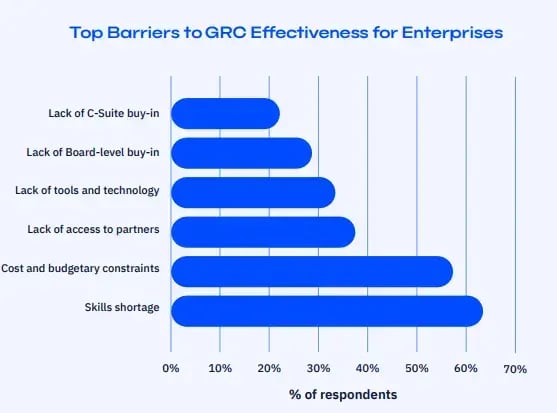
The data shows that even well-resourced enterprises face persistent barriers that undermine GRC effectiveness. Despite high confidence levels, leaders report significant challenges around skills shortages, budget constraints and limited access to the right tools and partners. Board and C-suite engagement is improving, but gaps remain, contributing to inconsistencies in oversight and slow progress on key initiatives. Together, these pressures reveal why mature organisations still struggle to operationalise GRC at scale.
The Reality Check:
Enterprise organisations cite several major challenges impacting their GRC performance.
- 63% report talent and budget gaps, with many lacking internal GRC expertise and more than half facing constrained budgets.
- 49% experience regulatory overload, managing five or more major regulations and struggling to keep pace.
- 60% still rely on manual workflows, including spreadsheets and manually built dashboards.
- Meanwhile, 62% operate with fragmented tooling, using four or more GRC tools, though fewer than half have integrated them effectively.
Despite projections of confidence by leaders, the reality for their practitioners is knowledge gaps, manual workflows and distributed data sets. The benefits of board involvement and high tool investment are lost as different departments and global regions are forced to collaborate and find meaning in a complex IT, cyber or enterprise technology ecosystem.
The Foundations Perspective
SMB Leaders Say is Going Well
Smaller organisations share some similarities to those larger enterprises, reporting high levels of GRC confidence, even in the face of resource and staffing constraints.
When surveyed, leaders highlighted several key strengths and points of pride:
- Resourceful teams: SMB GRC professionals consistently “make it work,” leveraging spreadsheets and manual processes to maintain oversight and adapt to evolving regulatory demands. Even when dedicated tools or budgets are limited, 70% believe they have adequate to even high capacity with flexibility for additional or urgent tasks.
- Agility and adaptability: Smaller teams cite agility as a core advantage, emphasizing their ability to pivot quickly and address compliance requirements on short notice, often without formalized process or large-scale systems.
- Commitment to capability: Despite limited headcount, 2/3rds of small teams rate their own GRC capacity as “moderate to good,” meaning they cover the essentials but occasionally face some weakness. However this is underscored by a strong culture of accountability and willingness to improve. 31% had made their first investment to either an in-house solution or a legacy GRC platform.
- Growing leadership engagement: Board and executive attention to GRC is on the rise, as leaders recognize the increasing impact of risk and compliance on organisational outcomes, even if formal engagement trails larger organisations.
From a distance, these factors suggest scaling teams are confident, adaptable, and determined to maintain compliance regardless of circumstance. The numbers point to a clear sense of preparedness and ownership. Yet, as with their enterprise peers, a closer look at the survey data reveals persistent challenges beneath the surface and a more complicated path to sustainable GRC maturity.
How SMB GRC Teams View Their Readiness:
- Incident Confidence: 93% of SMB GRC leaders believe their teams are prepared for a major GRC event.
- Affordable Methods: 86% of SMB respondents use spreadsheets or manual processes in some capacity, credited primarily to their affordability and ease of use.
- Perceived Capability: 63% of small teams rate their GRC capability as “moderate to good.”

The data shows that most SMBs feel reasonably prepared for a major compliance or cyber incident in the coming year, with 60% describing themselves as somewhat confident and an additional 33% reporting strong confidence. However, 7% still do not feel confident at all, reflecting ongoing capability gaps, reliance on manual processes and limited resources. This optimism–capability divide mirrors wider trends across the SMB landscape, where confidence remains high despite clear operational challenges.
The Reality Check:
-
i. 86% rely on spreadsheets and manual methods, with usage rising to 100% among SMB teams with only 1–5 GRC professionals.
ii. 84% face capacity strain, citing limited team size as the main driver of reactive task management and slow risk assessments.
iii. 41% have experienced a breach in the past 36 months, highlighting heightened exposure linked to limited resources and manual processes.
iv. 58% report operating in a reactive state, with only 6% believing they have the resources to take a proactive approach. Low budgets and simplicity keep teams dependent on spreadsheets and basic tools.
Despite a belief in their capability and preparedness for an event, many SMB teams suggested a reality that highlighted their own knowledge gaps. Heavy spreadsheet reliance, slow assessment processes and a high proportion of data breaches show an overconfidence that needs to be addressed not just with a larger investment but smarter methods.
Top barriers to GRC effectiveness for SMBs
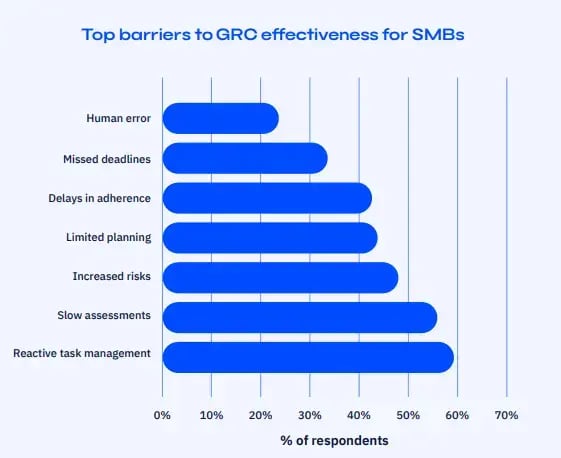
The data reveals that SMBs face a consistently reactive GRC environment, with reactive task management and slow assessments emerging as the two biggest barriers. These challenges are closely tied to limited capacity and heavy reliance on manual processes, which also drive increased risks and delays in regulatory adherence. Issues such as missed deadlines and human error further highlight the operational strain on small teams. Together, these findings show how stretched resources and a lack of structured workflows make it difficult for SMBs to stay ahead of compliance demands.
Whats the Difference?
Executives in both segments project confidence, but survey responses uncover meaningful contradictions about the state of GRC.
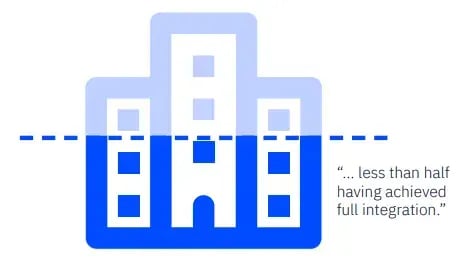
This visual highlights a key challenge uncovered in the report: most organisations are still operating with only partially integrated GRC tooling. While many use multiple platforms to manage risk, compliance and security, fewer than half have been able to fully connect these systems. The result is fragmented visibility, inconsistent data and additional manual work to bridge the gaps. Full integration remains an aspiration for many teams rather than a reality.
- Tools and processes are fragmented: Among Enterprises, organisations use multiple different GRC tools or processes, with less than half having achieved full integration. In SMBs, tool fragmentation is less about paid software and more about the layering of spreadsheets and manual, informal solutions. In both groups, disconnected approaches limit real-time visibility and slow down effective decision-making.
- Manual workflows persist: 60% of Enterprises and 86% of SMBs rely on spreadsheets for at least some of their GRC processes. Among the smallest SMB teams (those with 1–5 dedicated GRC professionals), spreadsheet use is universal.
- Talent, budget, and capacity gaps: Nearly 2/3rds of Enterprise respondents cite skills and budget shortages as barriers to GRC advancement. In SMBs, over 1/2 say limited team capacity and lack of specialist skills force them into reactive practises. GRC responsibilities are either distributed across multiple roles or shared against multiple responsibilities, heightening the risk of oversight lapses.
- Persistent risks and incident-driven change: Cyber threats, data privacy, and regulatory demands are top concerns for both groups. 41% of SMB organisations have experienced a breach in the last three years, often serving as the trigger for modernisation or tooling upgrades, rather than a proactive motivation.
These contradictions don’t undermine overall optimism, but they do complicate it. For both Enterprises and SMBs, the combination of fragmented tools, manual processes, and resource gaps leaves significant blind spots and operational risk. Closing the gap between confidence and control remains the defining challenge.
| Enterprise | SMB |
|---|---|
| Optimism masks operational blind spots | Confidence hides resource constraints and manual workarounds |
| Disconnected systems limit real-time visibility and slow decision-making | Reliance on spreadsheets and informal processes leads to unseen vulnerabilities |
| Persistent GRC problems become normalised, and innovation feels risky | Capacity and expertise gaps force teams into reactive, incident-driven management |
Enterprise confidence is high, but the scale and complexity of GRC infrastructure can create significant, often invisible, challenges. When programs appear mature supported by dedicated teams and advanced tooling, it’s easy to miss the cracks beneath the surface. Issues like tool sprawl, reporting delays, and incremental risk become routine rather than triggers for improvement. As a result, progress slows and innovation can stall. Programs that seem stable from the outside may operate in a cycle of maintaining the status quo, rarely interrogating the systems and assumptions that create their risk posture. The more mature a GRC function appears on paper, the less likely leaders are to ask what’s still missing.
For small businesses and mid-market organisations, the challenge is fundamentally different: less complexity at scale, and more about sustaining control with fewer resources. It is rare for teams to have the luxury of proactive GRC improvement. Over half of SMB respondents cite limited team capacity as their biggest operational barrier. Whilst leaders are proud of their ability to “make it work,” this normalization of workaround culture can leave major risks undetected until a crisis forces change. Progress is measured in survival and compliance rather than transformation. As a result, many SMB teams remain in a perpetual cycle of reaction, firefighting, and incremental fixes, without the bandwidth or resources to build lasting resilience.
“We’re falling behind when it comes to constantly changing regulations.”
- C-suite member of a £1 bn+ revenue organisation
The Reckoning
Openly acknowledging the challenges facing GRC is uncomfortable, but it’s essential for progress.
For many organisations, the “risk reckoning” begins when leaders choose to confront not just the most visible threats, but the operational gaps fragmented tools, manual workarounds, skills shortages, or capacity constraints that have become business as usual.
For enterprises, these gaps are often hidden behind complexity. Mature programs can mask real issues under layers of process, investment, and reporting. Integration is elusive, and persistent challenges like tool sprawl, delayed insights, and regulatory fatigue can become normalized, slowing real improvement. As a result, risk is not just an external threat, but a by product of systems that look robust, but struggle to adapt.
For SMBs or scaling GRC teams, the reckoning is shaped by resource limitations. Confidence and agility have helped teams survive, but the cost is perpetual overwork, fragmented oversight, and vulnerability to the unexpected. The normalization of spreadsheets, workarounds, and reactive management creates gaps that only become visible when incidents force a change. Without new approaches, teams risk being stuck in a cycle of firefighting and incremental fixes.
But this reckoning is also an opportunity. When leaders in both large enterprises and growing teams recognize that persistent challenges are not signs of failure—but signals for improvement—they can move from optimism to action.
Better visibility means better decisions: Whether it’s integrating separate tools, simplifying the stack, or performing a complete audit of all IT assets, gaining a comprehensive real-time view of risk and compliance is the key to targeted and proactive actions.
- Clarifying accountability and responsibilities reduces cost and confusion: Both enterprises and SMBs benefit when GRC roles are explicit, evidence is easy to collect, and reporting isn’t an afterthought.
- Fixing persistent challenges supports retention and resilience: Modernizing workflows reduces burnout, increases satisfaction, and allows scarce expertise to be used strategically, not just tactically.
- Maturity is a differentiator: Whether through platform integration, smarter workflows, or clearer reporting, organisations that can demonstrate true control, not just the appearance of it, will stand out to customers, partners, and regulators alike.
Risk isn’t going away. If anything, it’s multiplying. The organisations most willing to face uncomfortable truths about their GRC posture and address them will be best positioned to respond, recover, and lead.
Strategic Takeaways for Action
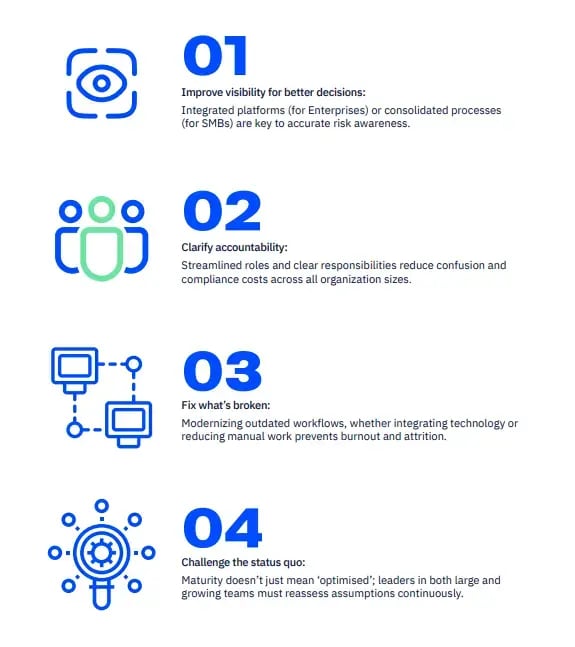
These four focus areas highlight where organisations can make the biggest impact on their GRC maturity. Improving visibility helps teams make better, faster decisions by relying on integrated platforms for enterprises or streamlined processes for SMBs. Clear role definitions reduce confusion and unnecessary compliance costs. Modernising outdated workflows prevents burnout and resolves long-standing inefficiencies. Finally, challenging assumptions ensures that leaders continuously reassess risks rather than assuming existing approaches are already optimised.
Enterprise vs. SMBs: GRC at a Glance
| Category | Enterprise | SMB |
|---|---|---|
| Confidence in GRC Preparedness | 87% claim preparedness for a major GRC event | 95% claim preparedness; confidence often based on manual methods |
| Main GRC Tools | 60% use spreadsheets (alongside other tools); but dedicated GRC platforms more common | 86% use spreadsheets; 100% of 1–5 person teams rely on them as main or supplementary tool |
| Integration & Fragmentation | 62% use 4+ GRC tools, only 45% have integrated platforms | Average of 2 tools; most have fragmented, manual/informal solutions (spreadsheets, email) |
| Resource & Capacity Gaps | 63% report skills gaps; 57% cite budget constraints | Over half cite limited team capacity as a key barrier |
| Regulatory Burden | 49% struggle to keep up with 5+ major regulations | Regulatory deadlines are a top driver for modernisation |
| Board/Leadership Engagement | GRC discussed at board level in 75% of firms | Engagement increasing but less formalised |
| Drivers for Tooling | Investment in automation, cyber intelligence, reporting | Cost and simplicity are top drivers; modernisation is often crisis-driven |
| Persistent Risks | Cyber threats, regulatory complexity, talent shortages | Same, but amplified by small team size and reactive approaches |
The Top-of-Mind Trends for UK GRC
Whilst the gap between perception and reality is vast, this hasn’t stopped an ambitious motivation for the future.
Top 5 UK Certifications of 2025
| Certification | Respondents Covered / Chasing |
|---|---|
| UK GDPR (UK’s specific General Data Protection Regulation) | 73% |
| Technology Code of Practice (TCoP) | 62% |
| ISO/IEC Standards (e.g., ISO 27001) | 50% |
| NIST Framework (from the U.S. National Institute of Standards and Technology) | 49% |
| EU NIS2 Directive (Network and Information Security Directive 2) | 47% |
Respondents at both the enterprise and SMB scales showed a clear weighting towards UK and EU regulations, with data privacy and commercial technology standards as the number one drivers either due to associated fines or barriers to partnership for non-compliance. North American regulations like SOX, SOC2 and HIPAA appeared only for organisations with global operations.
Top 5 Desired GRC Capabilities
| Capability | Representative Respondents |
|---|---|
| Real-time risk intelligence | 55% |
| Continuous controls monitoring | 53% |
| Regulatory change alerts / notifications | 45% |
| AI-based monitoring and insights | 38% |
| Cross-entity mapping | 18% |
vs. Top 5 GRC Objectives for 2026
| Objective | Representative Respondents |
|---|---|
| Strengthening broader cyber security | 47% |
| Leveraging AI for human efficiency | 46% |
| Improve risk-insights in decision making | 42% |
| Enhance visibility and oversight | 38% |
| Standardise GRC processes | 34% |
When it comes to objectives and improvement, leaders know where they want to go; there’s a desire for more AI, better oversight and stronger ties between GRC and cyber, but they are still navigating how to get there, with a gap in what that looks like for technology capabilities.
Organisations want AI to help their teams work smarter, but only a third are asking for AI features in GRC tooling. There’s a top-down intent to use AI, but little knowledge of how it can practically help and an uncertainty in the new risks that generative AI or LLMs present once adopted. Likewise, whilst process maturity is seen as important, there’s no clear consensus on what tools will get them there, with risk and compliance capabilities overstating governance with little mention of workflows or policy. What is certain, is that traditional tools are being less emphasized with a preference for proactive and intelligent systems (real time alerting, AI efficiencies and automation) over static dashboard reporting.
The Future
For both Enterprises and SMB organisations, the path forward in GRC is not just about adding tools or updating policies- it’s about building a sustainable, adaptive, and visible control environment that scales with risk.
SureCloud’s vision for the future of GRC is unified and actionable:
- Built for risk prevention and continuous compliance: Enterprises and growing teams alike will need to shift from reactive, fragmented workflows to integrated, real-time oversight. For large organisations, this means leveraging intelligent platforms to consolidate multiple systems, automate evidence collection, and surface risk insights across complex business units. For SMBs, it means moving beyond spreadsheets, adopting processes and tools that make compliance effortless, minimizing manual workload, and providing true visibility without breaking the budget.
- Confidence, best practice, and assurance- delivered faster: Regardless of size, organisations that put visibility at the heart of GRC will gain the agility to keep up with regulatory change, respond to incidents, and drive continuous improvement. By making risk, compliance, and controls easy to monitor and act on, leaders can future-proof their businesses, designing innovative products, launching new services, or entering new markets without losing control and facing financial, legal or reputational damages.
- The real risk isn’t just a breach or fine, it’s thinking everything is under control when it isn’t: In both Enterprises and SMBs, the danger lies in assumptions. SureCloud enables leaders to move beyond surface-level confidence, with practical, data-driven insights that drive improvement and assurance for every level of maturity.
The next generation of GRC is about delivering real-time insights and targeted automation. SureCloud offers two platforms to meet this challenge:
SureCloud Product Overview
| Foundations | Enterprise |
|---|---|
| Foundations is a purpose-built solution designed specifically for growing teams and SMBs. Designed for effortless control, it ensures quick compliance with frameworks like ISO/IEC 27001, GDPR and SOC2 through ready-to-use controls, unified first and third-party risk management and reporting that focuses on decision impact. It also helps teams move away from spreadsheets. | Enterprise is the most intelligent GRC platform. Powered by event-sourced architecture, it helps teams prioritise what matters most with contextual risk scoring, cross-framework control mapping and real-time reporting that drives outcomes. Enterprise enables mature teams to scale with confidence, simplify GRC complexity and refocus on organisational resilience. |
Whether you’re scaling up or already managing complex environments, SureCloud enables you to put visibility and control at the heart of your GRC strategy. Because only when you can see what’s coming can you decide what happens next.