Compliance Management
 Risk Management
 Third Party Risk Management
 Data Privacy Management
 Internal Auditing
 Business Continuity Management
 Continuous Control Monitoring (CCM)
 Trust Center
 AI Governance
- AI Governance
- 24th Apr 2026
- 1 min read
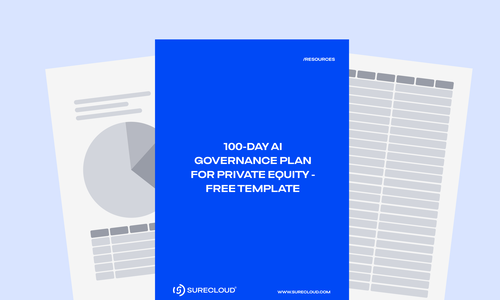
100-Day AI Governance Plan for Private Equity - Free Template

- Written by
AI is already in your portfolio companies. The question is whether you control it.
At our recent London event on AI value creation and risk mitigation for private equity, we opened with a single question for the room: how many of your portfolio companies have a named person accountable for AI governance right now?
Very few hands went up.
That gap, between how fast AI is moving inside portfolio companies and how much control investors actually have over it, is where portfolio value is being quietly eroded.
This article shares the governance framework we presented at the event. It also includes a free 100-day AI governance plan template you can put in the hands of every PortCo leadership team this week.
This is not a compliance story. It is a value creation story.
PE firms have always understood that governance protects exit value. Clean cap tables. Auditable financials. Documented IP ownership.
AI governance is the same discipline applied to a new and faster-moving risk.
The portfolio companies that govern AI well are already creating a measurable advantage. Proposal cycles shortened by 30%. Board pack preparation compressed from five days to four hours. Audit prep time cut by 75%. These are not projections. They are outcomes from AI programmes with a governance operating model behind them.
The ones that do not govern AI well are accumulating a different kind of value. Undisclosed shadow AI. Unvalidated decisions embedded in hiring, pricing, and operations. Fragmented architectures that make the cost of every new AI use case higher than it needs to be. And in M&A-built businesses, integration debt that is almost always underestimated at deal stage.
Governance failure rarely shows up as a legal problem first. It shows up as margin drag, rework, and a stalled AI programme.
Four failure modes we see consistently across PE-backed portfolios
Shadow AI. Employees across sales, marketing, and operations are using consumer AI tools outside any managed environment. There is no visibility, no data governance, and no way to audit which decisions have been shaped by AI outputs. In most portfolios, this is not a risk. It is a current reality.
Unvalidated decisions. AI-generated analysis is informing real business decisions before anyone has asked: who reviewed this, how was it generated, and what happens when it is wrong? The answers are usually: nobody, nobody, and we find out too late.
Fragmented architecture. Legacy tools, siloed data, and ungoverned prompts scattered across the organisation mean every new AI use case costs more than it should.
M&A integration debt. Many PE-backed businesses have grown through acquisition. Multiple ERPs, multiple CRMs, data sitting in incompatible systems. Before a coherent AI programme can be built, that integration debt must be resolved. The cost and timeline are almost always underestimated, both at deal stage and in the 100-day plan.
What good looks like: the governance operating model
The most effective framework for governing AI in a portfolio company follows five steps. Each builds on the last.
Discover. Map the actual tools in use, including shadow AI, the data flows, and the decisions already being influenced by AI outputs. You cannot govern what you have not mapped. Discovery is not a one-off audit. It is a continuous function.
Classify. Not all AI carries the same risk. A chatbot on a website is not the same governance challenge as an AI system influencing hiring decisions or credit assessments. Classify use cases using EU AI Act risk categories. High-risk use cases get intensive controls. Low-risk use cases get a lighter touch.
Control. Apply approval workflows, human review requirements, data handling policies, and third-party due diligence. Controls proportionate to classification. Governance without bureaucracy.
Monitor. AI systems are not static. They drift as data and usage patterns change. Monitoring means actively tracking whether controls are working, whether model behaviour has changed, and whether underlying data has shifted in ways that affect outputs. Most programmes fail here.
Evidence. Every control, every review, every incident: documented and auditable. When a buyer's diligence team asks about AI governance, you hand them a pack, not a conversation.
The 100-day plan: what we would ask every PortCo to do now
The framework above is not a multi-year transformation. It is a 100-day operating programme.
Month one. Appoint a named executive accountable for AI value and AI control, not a committee. Map every AI tool in use, sanctioned and shadow. Find the data flows, the high-risk workflows, and the decisions already in flight.
Months two to three. Build a use-case register. Each function lists its most repetitive, judgment-heavy, and customer-facing tasks. Select three to five pilots, each tied to a measurable outcome. Set controls from day one. Standardise in one operating workspace so prompts, process notes, owners, and approvals are visible.
End of quarter one. Publish the first board report. Scale only what is governed: every pilot that graduates to the operating model should have a documented owner, a review cadence, and a defined human oversight point.
The six questions every board pack should now answer on AI
These are the questions investors should be asking at every PortCo board meeting. If management cannot answer them cleanly, the AI programme is moving faster than governance.
- Where is AI creating measurable value today?
- Which use cases are high risk, and who signed them off?
- What shadow AI did we find this quarter?
- What third parties, models, and data sources do we depend on?
- What incidents, drift, or exceptions occurred?
- What evidence could we show a buyer tomorrow?
Question six is the exit question. Not in two years when a process is running. Tomorrow. If the answer is "we would need three months to pull that together", that is diligence risk sitting in the portfolio right now.
Download: the 100-Day AI Governance Plan template
We have built a practical Excel template that puts the entire framework into action. It covers:
- The 100-day planner with phased actions and owner tracking
- An AI usage map for inventorying sanctioned and shadow AI
- A use-case register for prioritising pilots by measurable impact
- A governance maturity scorecard across all five dimensions
- The board reporting template built on the six questions above
It is designed to be handed directly to a PortCo leadership team.

Regulatory context: why the window to act is now
The EU AI Act is phasing in through 2027. High-risk AI use cases, those influencing hiring, credit assessment, and safety-critical operations, are already within scope in the portfolio companies of most institutional investors.
DORA is in active enforcement for financial services. NIS2's full compliance deadline is October 2026. FCA fines in Q1 2026 alone totalled £15.7M.
For PE firms, regulation creates two specific pressures. Portfolio companies that cannot demonstrate AI governance maturity are carrying diligence risk that compounds as you approach an exit process. And the cost of retrofitting governance onto an ungoverned AI programme is always higher than building it correctly from the start.
The window to act is measured in months, not years.
How SureCloud helps PE-backed companies govern AI at speed
SureCloud is a GRC platform built for organisations that need to do more, better, with less. For PE-backed businesses, that means getting the governance operating model in place quickly, without building a team around it.
Gracie AI Agents with Personas and Skills maps directly onto your existing GRC team structure. Every agent has a defined role: Risk Manager, Compliance Lead, Internal Auditor, Vendor Risk Manager. Every action is auditable, governed, and explainable.
Where most AI in GRC helps teams write things down, SureCloud gets the work done.
Our Assure package can be live in as fast as one week. For more complex programmes, QuickStart gets teams to full deployment in three to four weeks.
SureCloud has been building GRC software since 2006. Recognised in Gartner Magic Quadrant and Verdantix AI Applied Radar 2025. Trusted by organisations across financial services, legal, manufacturing, and critical infrastructure.
Found this useful?
Choose SureCloud as a preferred source in Google and you will see more of our GRC guidance in Top Stories, AI Overviews and AI Mode. It takes one click and you can undo it at any time.
Let Gracie get the work done.
Gracie drafts summaries, evidence requests and audit narratives across your programme — you stay in control.
See Gracie in action or book a full platform demo →See what SureCloud costs
A short form, no sales call. Pricing built around your GRC estate.
Get PricingIDC names SureCloud the industry's first cross-domain agentic GRC platform
Read the independent analyst view on how SureCloud is redefining risk and compliance.
Download for free
.webp)

“In SureCloud, we’re delighted to have a partner that shares in our values and vision.”

Read more on how Mollie achieved a data-driven approach to risk and compliance with SureCloud.
“In SureCloud, we’re delighted to have a partner that shares in our values and vision.”
Read more on how Mollie achieved a data-driven approach to risk and compliance with SureCloud.
“In SureCloud, we’re delighted to have a partner that shares in our values and vision.”
Read more on how Mollie achieved a data-driven approach to risk and compliance with SureCloud.