Compliance Management
 Risk Management
 Third Party Risk Management
 Data Privacy Management
 Internal Auditing
 Business Continuity Management
 Continuous Control Monitoring (CCM)
 Trust Center
 AI Governance
- Agentic AI
- 25th Feb 2026
- 1 min read
AI in GRC: How AI Agents Transform Governance & Compliance 2026

- Written by
In Short..
TLDR: 4 Key Takeaways
- The audit-era model of GRC is ending. Periodic reviews and manual evidence collection can’t keep pace with AI-driven, digitally connected enterprises.
AI agents are transforming GRC operations. Automated evidence collection, continuous monitoring and real-time reporting reduce audit fatigue and improve accuracy.
GRC is shifting from cost centre to growth engine. When controls are intelligent and embedded, they accelerate sales, strengthen trust and support expansion.
Boards now expect live risk intelligence. AI-enabled GRC provides real-time clarity, predictive insight and stronger alignment between risk and revenue.
AI in GRC is not a feature upgrade — it is an operating model shift. Organisations that embed intelligent automation now will redefine governance as strategic infrastructure by 2026.
Introduction
GRC is no longer a periodic, back-office function. As AI and digital systems reshape the enterprise, governance, risk and compliance must become continuous, automated and strategic.
The question for boards is not whether to modernise GRC, but whether their current model can deliver real-time oversight in an AI-driven environment.
In 2026, AI agents will shift GRC from reactive compliance to proactive, intelligence-led assurance.
The End of Audit Era GRC
For decades, governance, risk and compliance has operated as a retrospective function. Controls were tested after the fact. Evidence was collected manually. Reporting cycles were periodic. Risk insight lagged business reality.
That operating model is no longer fit for purpose.
As stated in the 2026 GRC Forecast,
“In 2026, GRC continues to evolve from an audit era back office function into a strategic, technology AI driven platform of trust, embedding risk, third party oversight, and automation into enterprise decisions, giving boards real time clarity, reducing audit fatigue, strengthening resilience, and transforming GRC into a driver of growth.”
- Rui Dos Ramos, Head of Presales
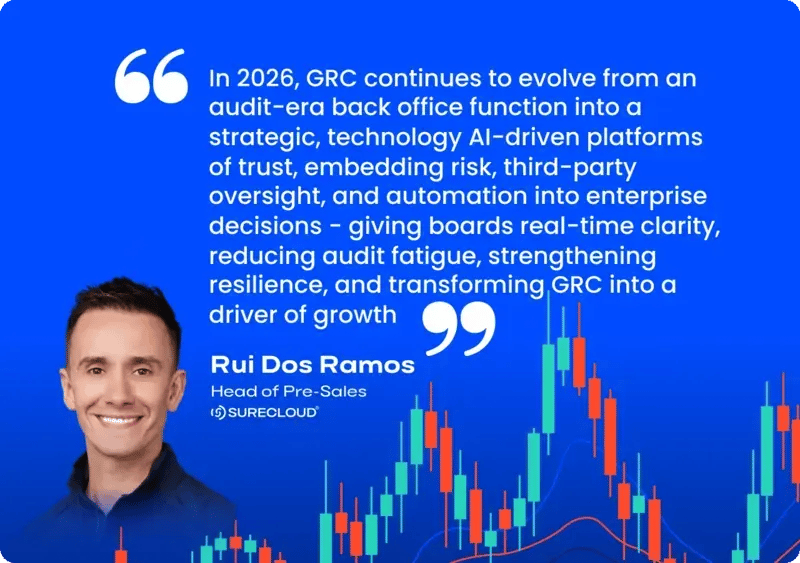
This signals a decisive shift away from compliance administration and towards strategic enablement.
In 2026, organisations will face:
- Increasing regulatory scrutiny
- Expanding third party ecosystems
- Accelerating digital transformation
- AI embedded across enterprise systems
- Boards demanding real time clarity
GRC must evolve into an intelligent decision layer that supports business velocity rather than constrains it.
What Is AI in GRC?
AI in GRC refers to the use of machine learning, automation and intelligent agents to improve how governance, risk and compliance functions operate.
This includes:
- Automated evidence collection
- Continuous control monitoring
- Intelligent anomaly detection
- Dynamic third party risk scoring
- Real time board reporting
- AI assisted recommendations
It shifts GRC from static documentation to continuous oversight.
Traditional GRC vs AI Enabled GRC
Traditional GRC is periodic, manual and reactive.
AI enabled GRC is continuous, automated and predictive.
Traditional approaches rely heavily on spreadsheets and point in time audits.
AI enabled models integrate directly with enterprise systems and generate live insight.
The Rise of AI Agents in Risk Operations
The most transformative element is the deployment of AI agents within GRC workflows.
The forecast notes,
“AI agents will help to reduce the burden on routine GRC activities such as evidence collection and initial collation of data, while people focus on reviewing the outputs and making decisions and recommendations.”
- Matt Davies, CPO
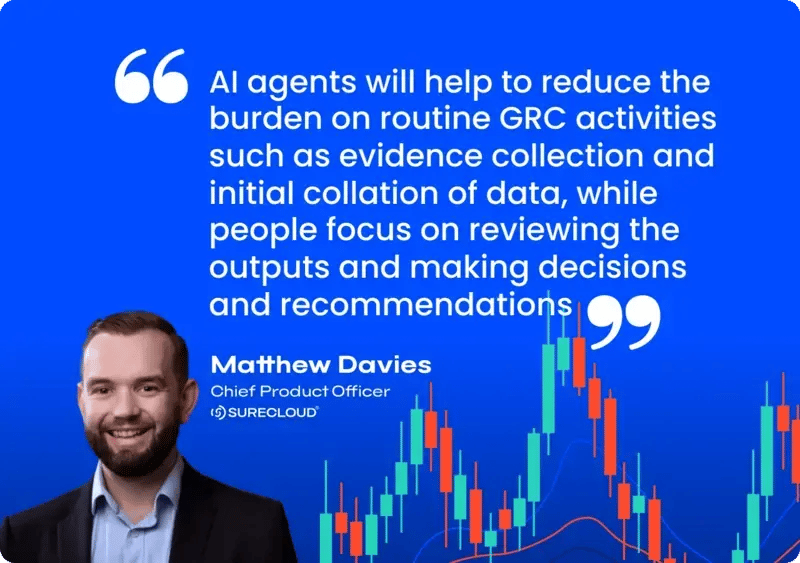
An AI agent in this context performs defined compliance tasks autonomously while remaining under human oversight.
Automated Evidence Collection
AI agents integrate with HR systems, cloud infrastructure, identity management tools and financial platforms. They pull required control evidence automatically rather than relying on manual requests.
Impact includes:
- Reduced audit fatigue
- Improved data accuracy
- Faster audit cycles
Third Party Risk Monitoring
As organisations become more interconnected, supplier exposure increases.
The forecast reinforces this reality:
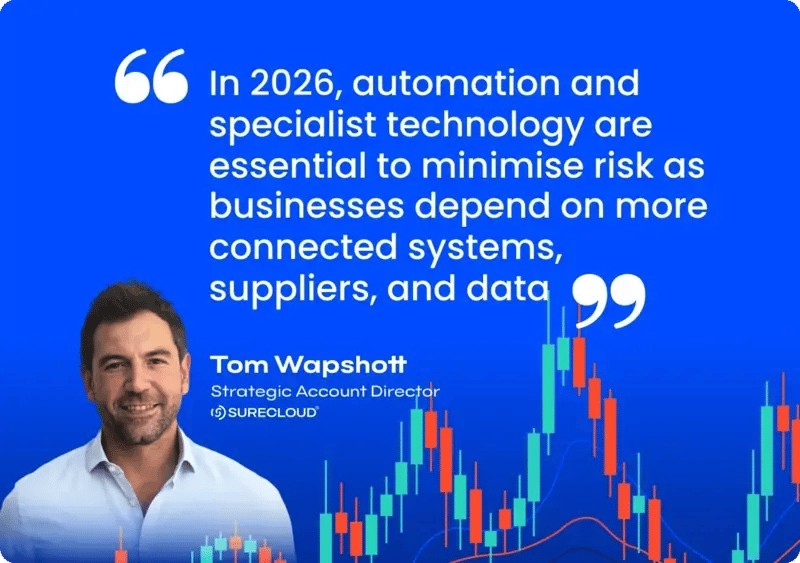
“In 2026, automation and specialist technology are essential to minimise risk as businesses depend on more connected systems, suppliers, and data.”
- Tom Wapshott, Strategic Account Director
AI agents continuously monitor supplier posture using live signals rather than annual assessments.
Continuous Control Validation
Control effectiveness is validated in real time. Deviations are flagged early, reducing regulatory exposure.
Real Time Board Reporting
Risk data is aggregated and translated into executive level insight aligned with risk appetite and strategic objectives.
From Compliance Cost to Growth Engine
One of the most important insights from the forecast is this statement:
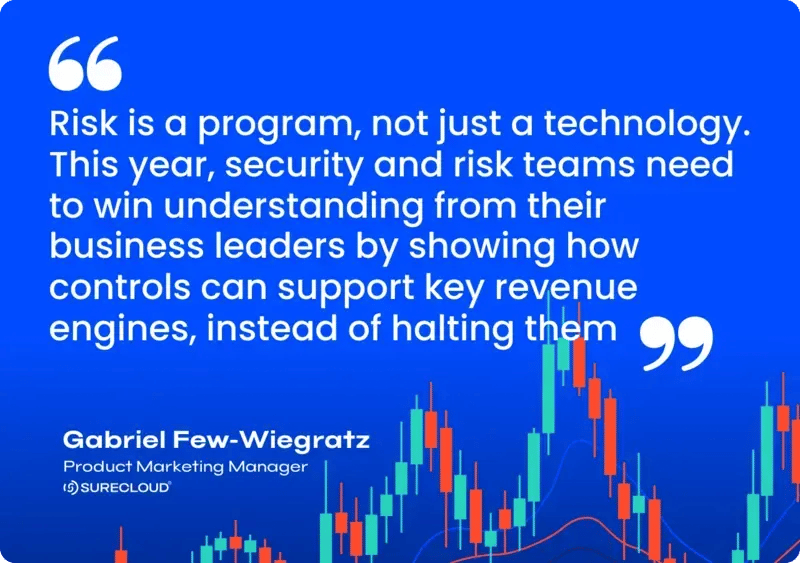
“Risk is a program, not just a technology. This year, security and risk teams need to win understanding from their business leaders by showing how controls can support key revenue engines, instead of halting them.”
- Gabriel Few-Weigratz, Product Marketer
This reframes GRC as a growth enabler.
When AI reduces friction:
- Assurance responses accelerate sales cycles
- Customer trust increases
- Market expansion becomes smoother
- Regulatory confidence strengthens
Trust becomes operational infrastructure.
The Intelligent GRC Framework
To operationalise AI in GRC, organisations require structure.
1. Connected Data Foundation
Unify cyber, compliance, risk and third party datasets into a consistent taxonomy.
2. Continuous Monitoring Layer
Replace periodic reviews with automated validation across control environments.
3. AI Agent Deployment
Deploy agents across:
- Evidence collection
- Regulatory mapping
- Third party monitoring
- Control testing
4. Human Decision Layer
AI reduces workload but accountability remains human. Risk professionals interpret and decide.
5. Board Intelligence Interface
Translate risk metrics into strategic business insight that boards can act upon.
Board Level Implications
Boards now expect:
- Immediate clarity
- Alignment between risk and revenue
- Demonstrable resilience
- Transparent third party oversight
AI enabled GRC supports:
- Live risk appetite tracking
- Faster incident reporting
- Predictive scenario modelling
- Clear linkage between controls and growth
Governance becomes forward looking.
Implementation Roadmap for 2026
Phase 1: Assess Data Readiness
Map systems, remove silos, standardise terminology.
Phase 2: Automate High Friction Tasks
Begin with evidence collection and control attestations to generate quick efficiency gains.
Phase 3: Introduce AI Monitoring
Deploy agents for supplier oversight, anomaly detection and continuous control validation.
Phase 4: Align to Strategic Objectives
Embed risk insight into expansion plans, mergers and digital transformation initiatives.
Phase 5: Elevate Board Reporting
Shift from static dashboards to narrative intelligence supported by live data.
Common Pitfalls to Avoid
- Treating AI as a feature rather than an operating model shift
- Failing to ensure data quality
- Over automating without governance controls
- Ignoring explainability requirements
AI in GRC must remain transparent and defensible.
Why 2026 Is the Inflection Point
Regulatory expansion, digital interdependence and maturing AI capability converge.
The forecast clearly signals that automation and AI are foundational to resilience and growth, not optional enhancements.
Organisations that move early will redefine governance as strategic infrastructure.
Conclusion: Reinventing GRC for Strategic Growth
GRC in 2026 will be defined by intelligent automation, embedded oversight and real time clarity.
AI agents are not simply efficiency tools.
They represent the structural evolution required to transform governance from administrative necessity into competitive advantage.
Found this useful?
Choose SureCloud as a preferred source in Google and you will see more of our GRC guidance in Top Stories, AI Overviews and AI Mode. It takes one click and you can undo it at any time.
Let Gracie get the work done.
Gracie drafts summaries, evidence requests and audit narratives across your programme — you stay in control.
See Gracie in action or book a full platform demo →See what SureCloud costs
A short form, no sales call. Pricing built around your GRC estate.
Get PricingIDC names SureCloud the industry's first cross-domain agentic GRC platform
Read the independent analyst view on how SureCloud is redefining risk and compliance.
Download for free
.webp)
“In SureCloud, we’re delighted to have a partner that shares in our values and vision.”

Read more on how Mollie achieved a data-driven approach to risk and compliance with SureCloud.
“In SureCloud, we’re delighted to have a partner that shares in our values and vision.”
Read more on how Mollie achieved a data-driven approach to risk and compliance with SureCloud.
“In SureCloud, we’re delighted to have a partner that shares in our values and vision.”
Read more on how Mollie achieved a data-driven approach to risk and compliance with SureCloud.