


43°CThe median GRC temperature of the 703 UK organisations we read
Research report
How hot is GRC?
The UK GRC Temperature Report 2026
In 2026 we’ve shared that the temperature is rising across new regulations, complex supply chains, shadow tooling and an unprecedented GRC workload. Now we’ve measured it.
01The reading
Most organisations we read run hot.
73%read Hot
Median: 43°C. Nearly 3/4 of the organisations we scanned are Hot before we have asked them a single question about their own team.
Above or below the 43°C median?Take your temperature
Download chart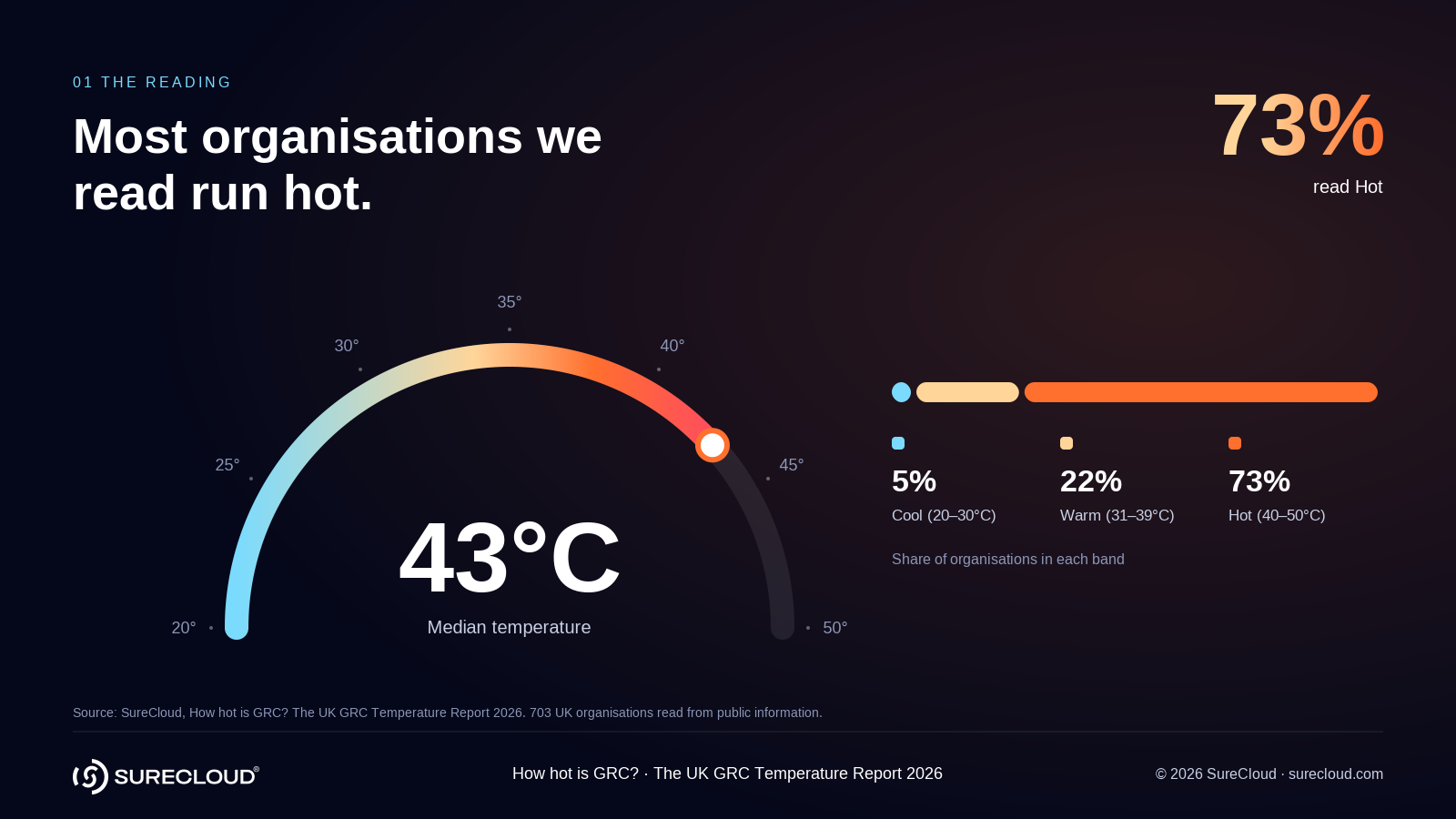
- 5%Cool20–30°C
- 22%Warm31–39°C
- 73%Hot40–50°C
02AI
AI is becoming a compliance necessity.
30.4%of all the organisations we read: the EU AI Act may apply
43.8% publicly use or build AI. 69.5% of those also serve the EU, so the EU AI Act may apply to 30.4% of all the organisations we read. Their customers may also ask for ISO/IEC 42001.
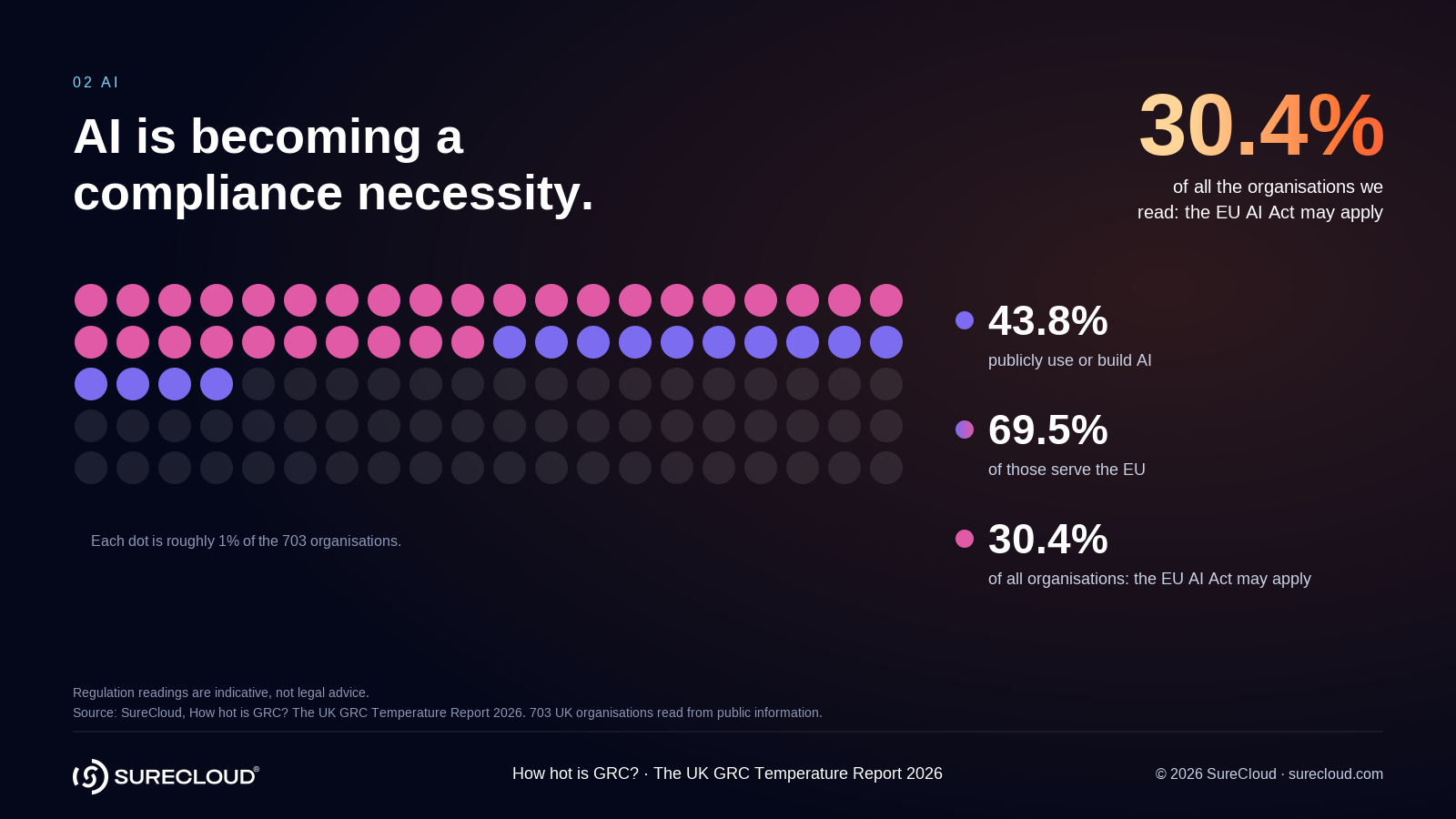
- 43.8%publicly use or build AI
- 69.5%of those serve the EU
- 30.4%of all organisations: the EU AI Act may apply
03Industries
Technology and SaaS runs hottest.
44.5°CTechnology and SaaS, first of the 7 sectors we can show
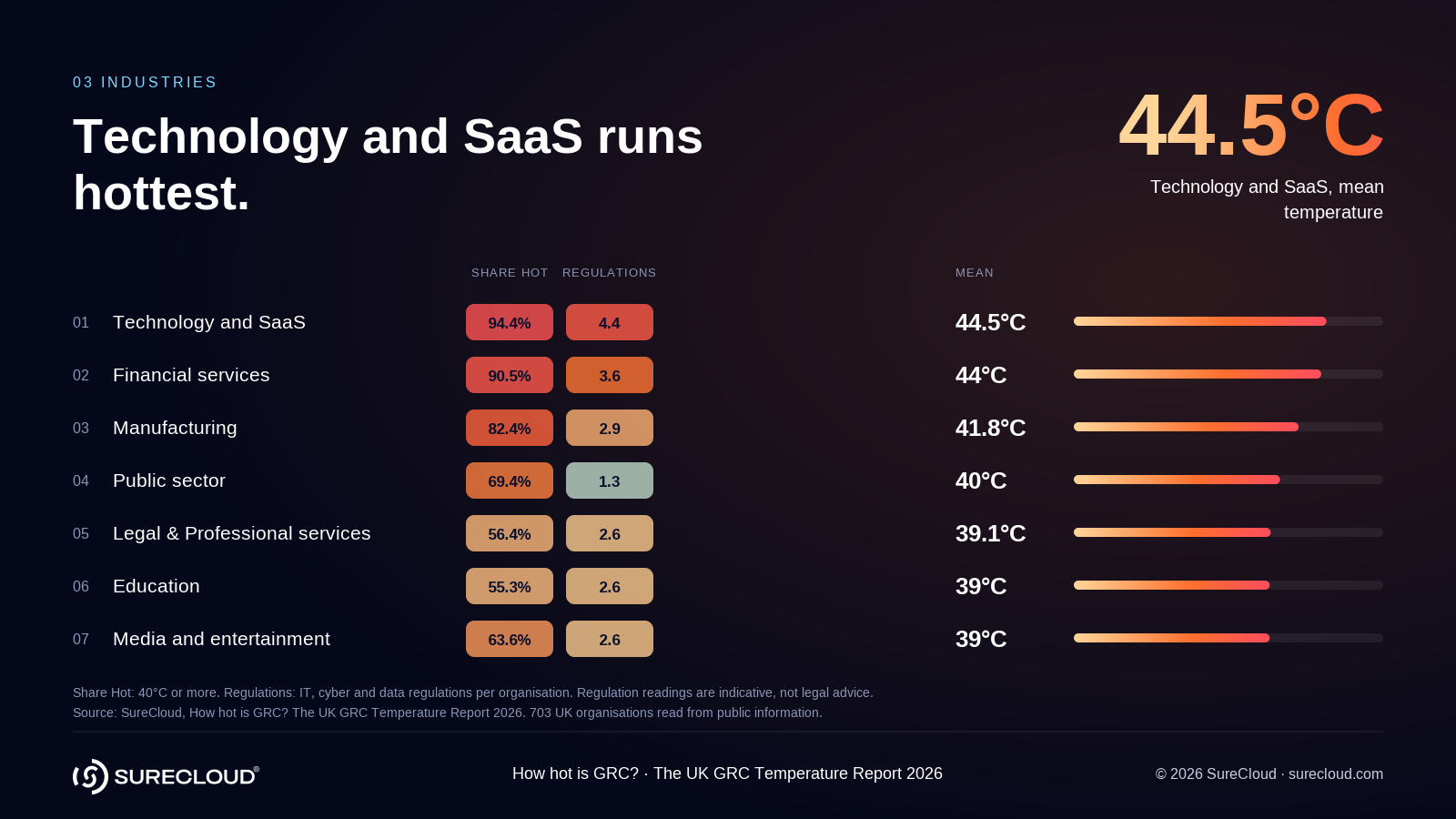
- 01Technology and SaaS94.4%4.444.5°C
- 02Financial services90.5%3.644°C
- 03Manufacturing82.4%2.941.8°C
- 04Public sector69.4%1.340°C
- 05Legal & Professional services56.4%2.639.1°C
- 06Education55.3%2.639°C
- 07Media and entertainment63.6%2.639°C
Share Hot: organisations reading 40°C or more. Regulations: IT, cyber and data regulations in force or likely, per organisation.
04Size
Size has a clear pattern with GRC temperature
35.5°45.5°C1–49 people to 10,000+
Fastest in the first 250 people, the bigger the company the more they typically fell in scope of regulations
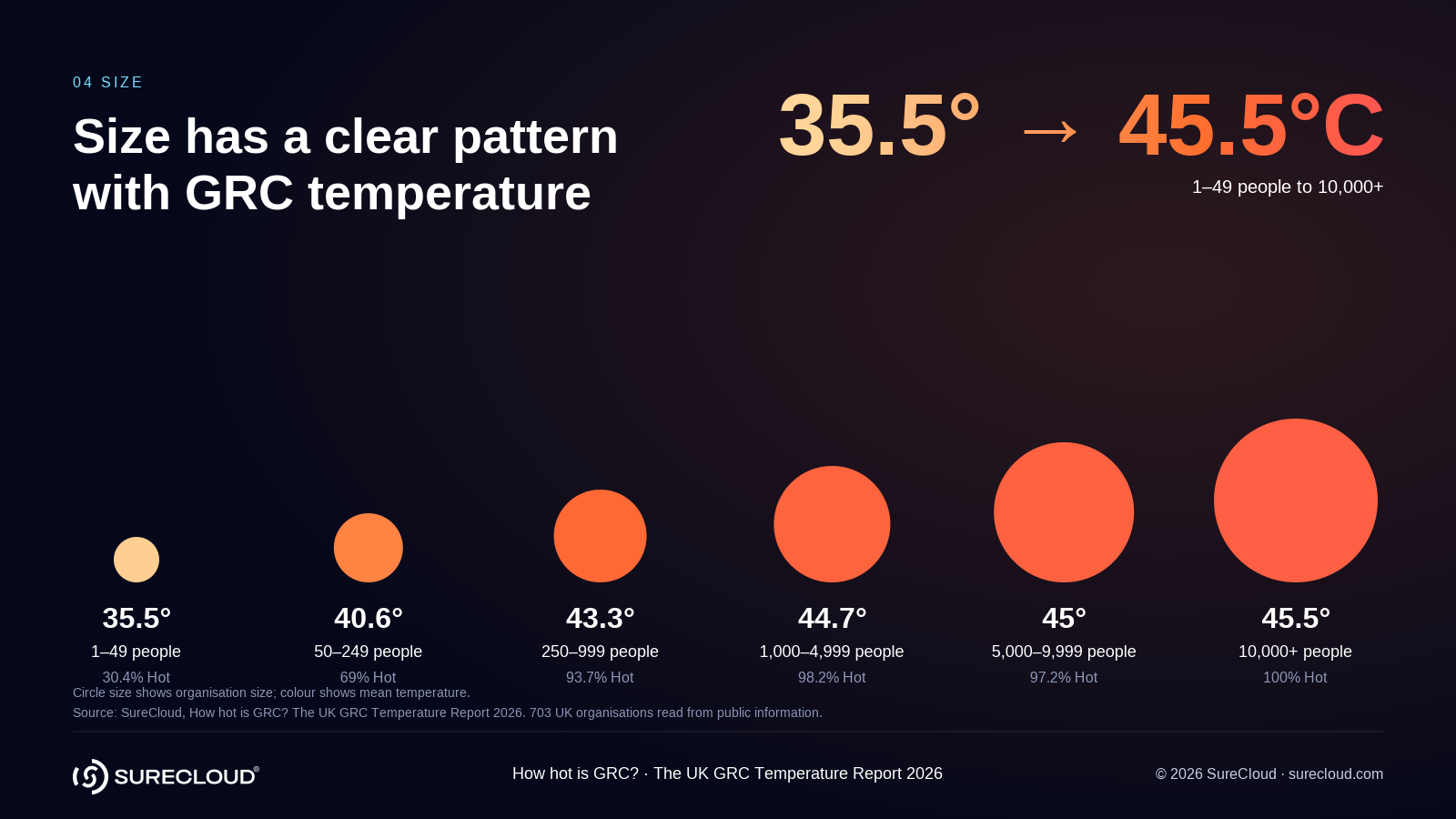
- 35.5°1–4930.4% Hot
- 40.6°50–24969% Hot
- 43.3°250–99993.7% Hot
- 44.7°1,000–4,99998.2% Hot
- 45°5,000–9,99997.2% Hot
- 45.5°10,000+100% Hot
05Regulations and standards
Enforceable IT and privacy regulation is stacking up.
3.1IT, cyber and data regulations in force or likely, on average
The average organisation faces 3.1 IT, cyber and data regulations in force or likely. 26.9% face five or more. Whilst every company scanned faced UK GDPR, a further half also had to make considerations for EU GDPR.
The report focused on IT, cyber and data regulations. "Applies" means the law covers the organisation. "Likely" means it may, depending on details we can't see from outside. "Coming" laws aren't yet in force and add nothing to the temperature.
How many apply to you?Take your temperature
Download chart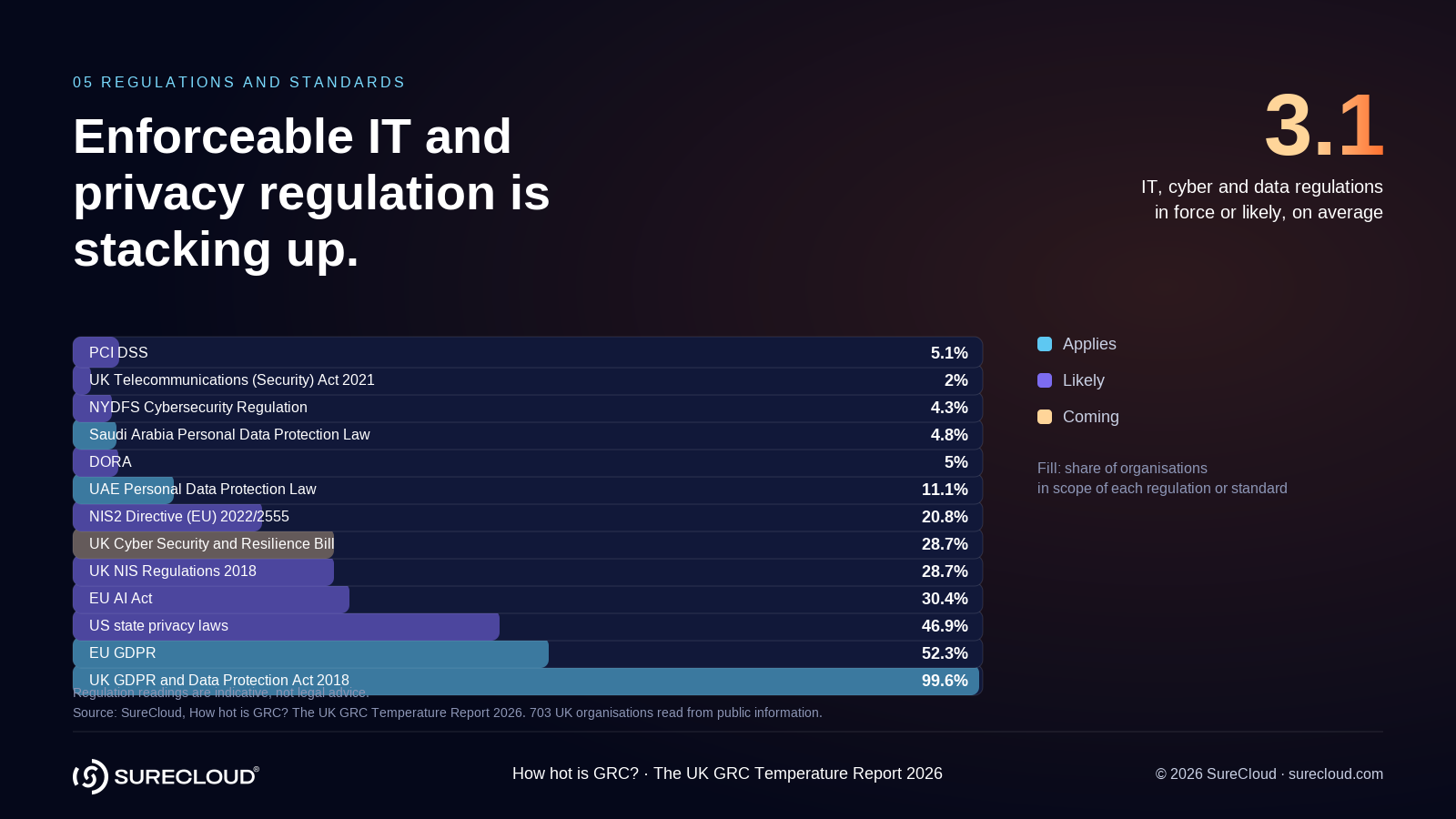
- UK GDPR and Data Protection Act 201899.6%
- EU GDPR52.3%
- US state privacy laws46.9%
- EU AI Act30.4%
- UK NIS Regulations 201828.7%
- UK Cyber Security and Resilience Bill28.7%
- NIS2 Directive (EU) 2022/255520.8%
- UAE Personal Data Protection Law11.1%
- DORA5%
- Saudi Arabia Personal Data Protection Law4.8%
- NYDFS Cybersecurity Regulation4.3%
- UK Telecommunications (Security) Act 20212%
- PCI DSS5.1%
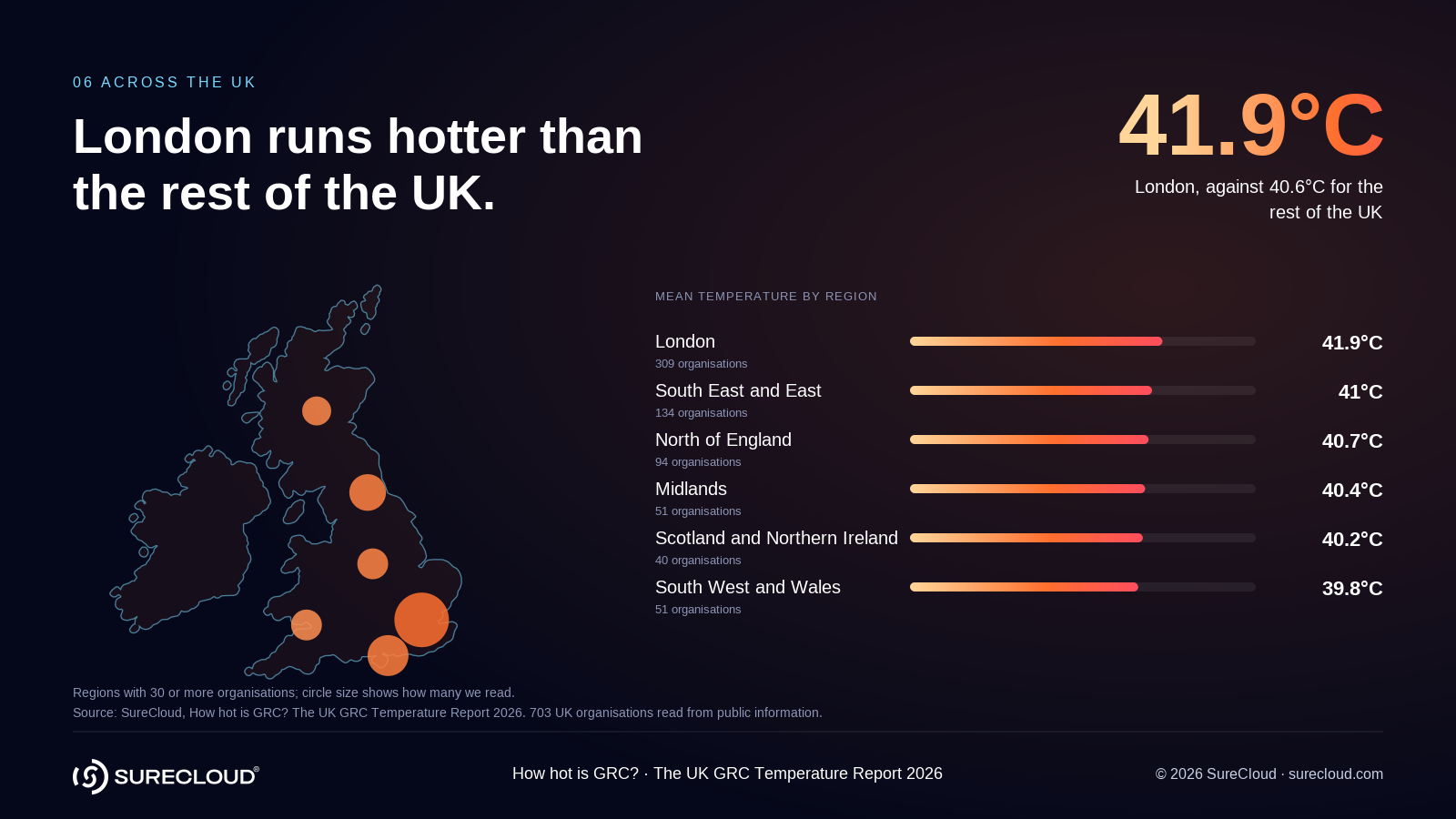
- 39.8°C South West and Wales
- 40.2°C Scotland and Northern Ireland
- 40.4°C Midlands
- 40.7°C North of England
- 41°C South East and East
- 41.9°C London
06Across the UK
London runs hotter than the rest of the UK.
41.9°CLondon, against 40.6°C for the rest of the UK
41.9°C against 40.6°C, with 3.5 regulations per organisation against 2.7. The gap comes from reach, AI and size: 64.4% of London organisations serve the EU, against 44.3% elsewhere.
- London41.9°C3.5 regulations per organisation
- Rest of the UK40.6°C2.7 regulations per organisation
07Third parties
One supplier was found on most homepages.
83.3%of the homepages we read load at least one Google service
The median homepage loads 5 third-party services. 55.1% load five or more, enough to reach the scoring's warm threshold. 3% reach the hot threshold of 15. One loads 32.
Share of the 610 homepages we could read.
Download chart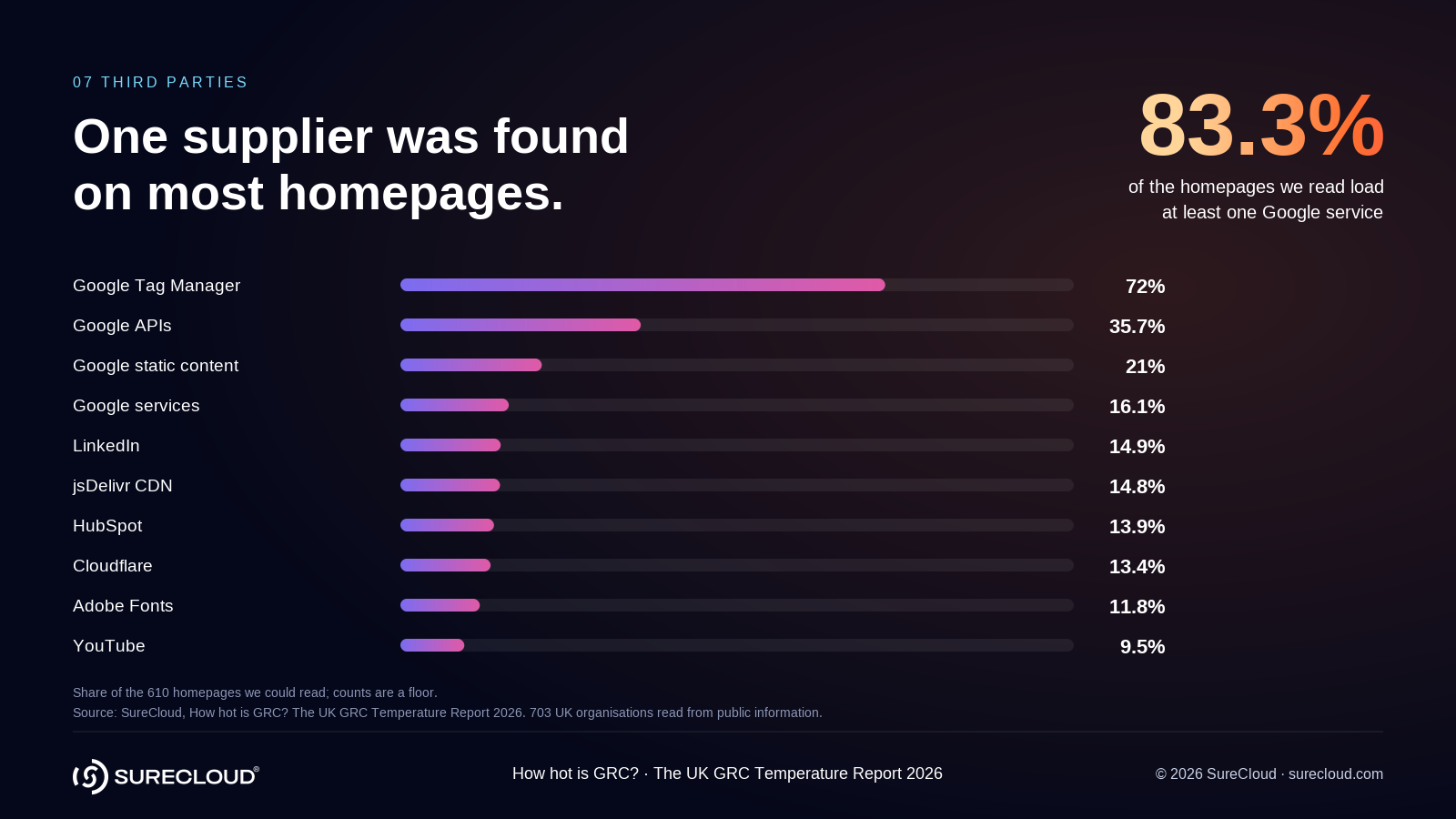
- Google Tag Manager72%
- Google APIs35.7%
- Google static content21%
- Google services16.1%
- LinkedIn14.9%
- jsDelivr CDN14.8%
- HubSpot13.9%
- Cloudflare13.4%
- Adobe Fonts11.8%
- YouTube9.5%
08Assurance
BUT the proof is rarely on show.
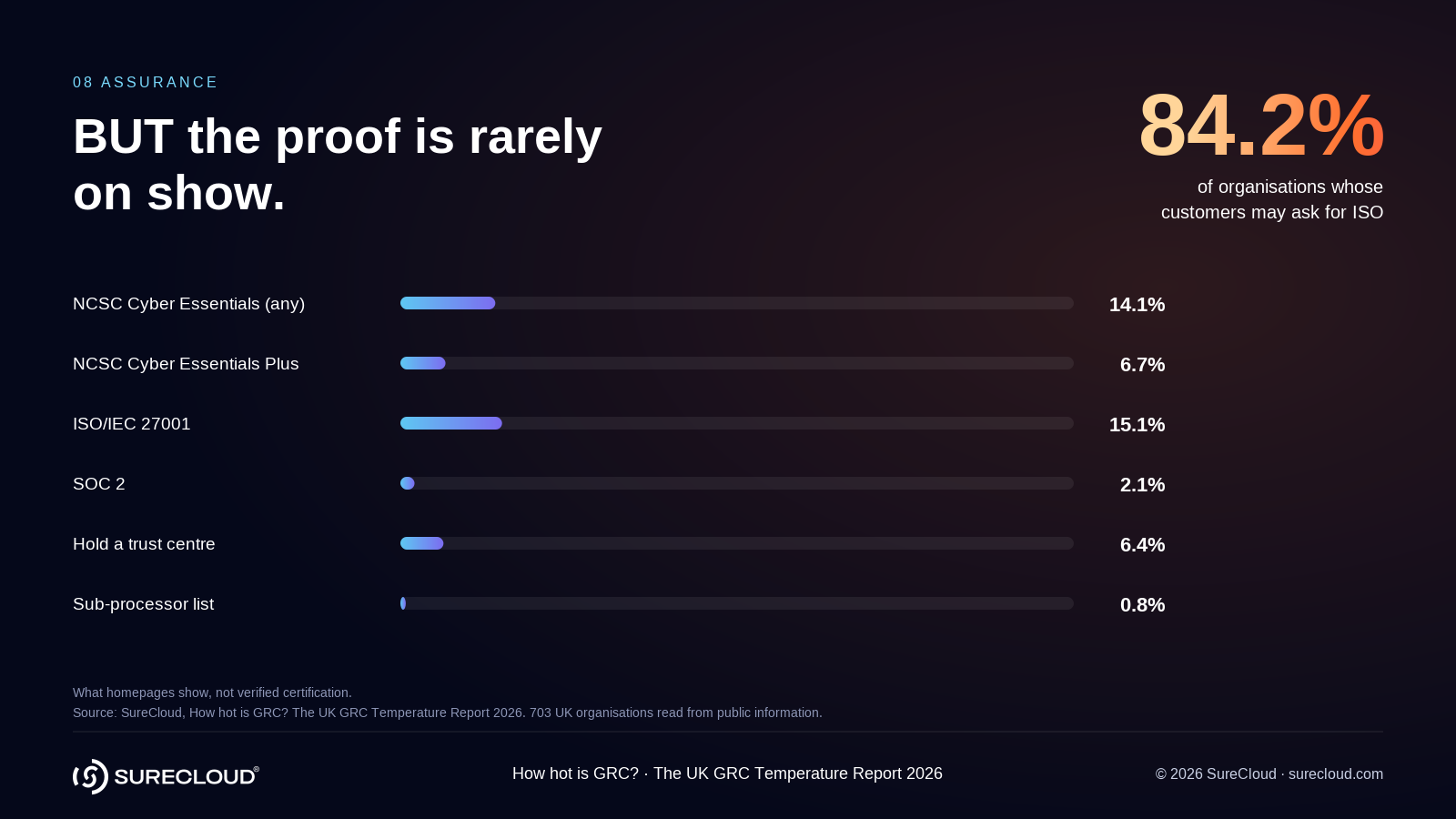
84.2%of organisations whose customers may ask for ISO 27001 don't show certification on their public website
09Email
Fewer than half reject spoofed email outright.
43%of domains ask receiving servers to reject spoofed email
We also checked one signal the temperature doesn't score: whether an organisation's domain tells receiving servers what to do with email that fakes it. The control is called DMARC.
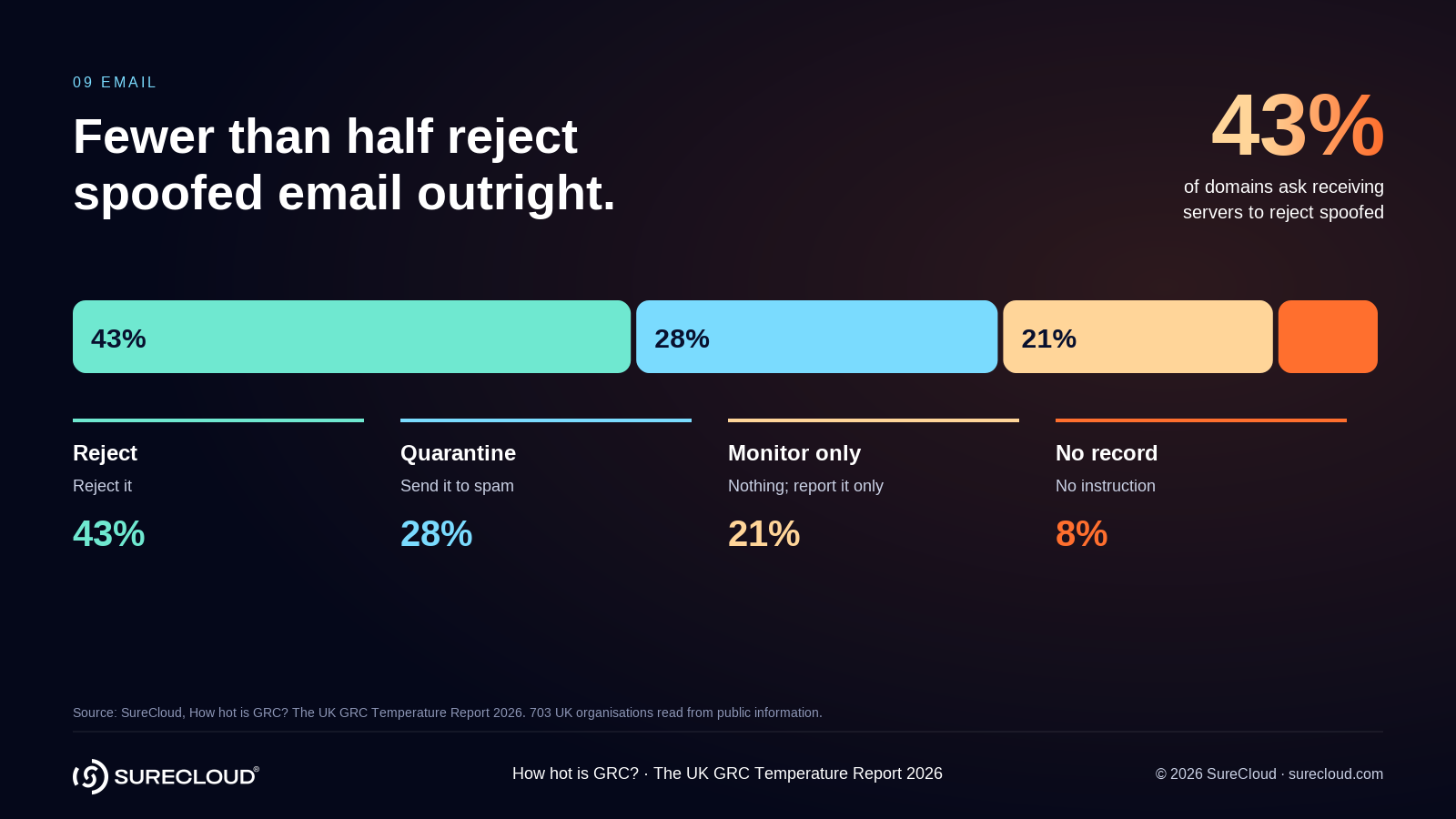
- RejectReject it
- QuarantineSend it to spam
- Monitor onlyNothing; report it only
- No recordNo instruction
10SureCloud's view
GRC does not have a knowledge problem, it has a capacity one.
GRC teams know what good looks like but they lack the hours to research, record, chase, evidence, assess and monitor across every framework, every supplier and every risk.
Each of these findings paints a picture of external obligation and each adds work. For many organisations these pressures are stacking up too fast.
In SureCloud's view, the bands describe how far the work reaches
- CoolHere the GRC is contained. The work can sit with a few people alongside their day jobs.
- WarmGRC reaches across the business and the work needs a named employee and a plan.
- HotGRC is persistent, they typically need dedicated teams and specialists to handle the heat.
Which band is yours?Take your temperature
11Taking the heat off
Here are 5 areas SureCloud recommends to change that
- 01
Test once, use everywhere.
- 02
Make third-party risk continuous.
- 03
Get ahead of AI.
- 04
Close the easy gaps.
- 05
Know what your customers will ask you to prove.
The average organisation we read faces 3.1 regulations in force or likely. Customers may ask 93.2% for ISO/IEC 27001, 46.9% for NIST CSF and 46.7% for SOC 2. Much of what they ask for overlaps. You should be able to map a control once and use the same evidence and same tests for every framework that needs it.
The median homepage we read loads five third-party services. 72% run Google Tag Manager, which can add tags without anyone touching the site's code. Point-in-time reviews can't keep up with that. Review suppliers as they change with continual vendor scanning, not once a year.
43.8% of the organisations we read use or build AI, and 69.5% of those serve the EU, where the EU AI Act may set duties. Start with an inventory of where AI is used. Then map it to the EU AI Act and to what customers may ask under ISO/IEC 42001.
Only 42.7% reject spoofed email, and among organisations under 50 people it's 16.8%. Moving DMARC to reject as part of a phased approach of monitoring, quarantining and rejecting is within many teams’ reach. So is showing the assurance you already hold: only 26.5% of homepages show any proof of infosec capability.
Of organisations whose customers may ask for ISO 27001, 84.2% don't show it on their public website. In our view, this is the cheapest gap to narrow: where an organisation already holds a certificate, showing it costs little. A trust centre, which 6.4% of homepages show, answers the question before a buyer asks it.
You can do more with less, and do it better.
SureCloud is the platform built to close this gap, helping teams shift to a continuous, automated approach wherever they sit. Gracie AI extends your reach performing your real GRC tasks through Agents, ensuring they’re done to repeatable standard based on your own internal expertise with Skills, and making use of Personas, with 20 years of practitioner knowledge to surface insights and help you act on your data. For once your team leads the programme rather than chases it.
How we did it703 UK organisations · public information only
The sample. We read 703 UK organisations from a list of UK suppliers, with organisations added in five focus industries: financial services, manufacturing, public sector, legal and critical infrastructure. The sample doesn't represent all UK organisations, so this report speaks about the organisations we read. We only report groups of 30 or more organisations.
This is a public reading and the external temperature is just one part of the puzzle. This report can't see audit pressure, evidence scattered across inboxes or a team that spends its week firefighting. The live Temperature Check asks additional questions about those factors, so a visitor's own result can differ from this public reading.
What the public reading can't see
What's your temperature?
Every organisation in this report was scored with the same rules. Run the check on your own, and answer five questions only your team can.
- Frameworks
- Audit evidence
- Vendor reviews
- AI visibility
- Capacity
A public reading of 703 UK organisations, November 2026. Your answers on frameworks and vendors take the place of the regulation and third-party readings, so your result may differ from the figures here. Regulation readings are indicative, not legal advice.